

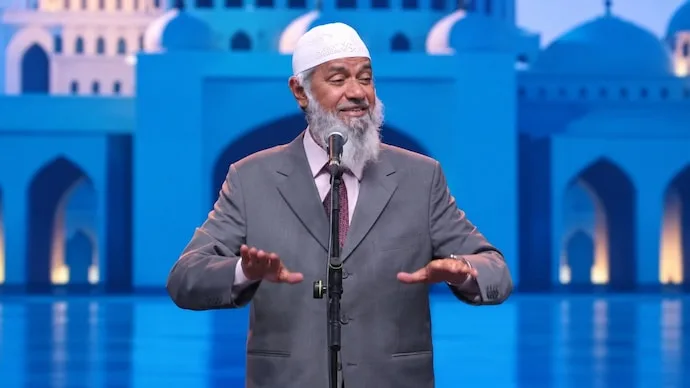

Zakir Naik on girls’ education has become the subject of fresh controversy after the Indian preacher defended the Taliban’s restrictions on female students in Afghanistan. His remarks, suggesting that secondary and higher education had been delayed rather than permanently banned, triggered criticism from Indians, Pakistanis and Afghans, including activists, academics and journalists.
In a video clip, Naik claimed that the Taliban had restricted girls’ education beyond Class 6 because of security concerns and a shortage of female teachers. He also argued that Afghan women could pursue advanced studies in Islamic subjects, including Sharia, Arabic and the Quran.
Naik said he had personally spoken to Taliban representatives and questioned media coverage of the restrictions. He maintained that postponing education until suitable teachers and a secure environment were available was not necessarily problematic.

However, his explanation was challenged by critics who argued that an indefinite closure of schools and universities effectively denies girls their right to education.
UN Figures Contradict Zakir Naik’s Claims
According to UNICEF, more than 2.6 million Afghan girls have been denied secondary education since the Taliban returned to power in August 2021.
Girls have been barred from formal education beyond Class 6 since September 2021. In December 2022, the Taliban extended restrictions to women attending universities. Further restrictions in December 2024 prevented women from attending medical training institutions, including nursing and midwifery programmes.
Afghanistan remains the only country where secondary and higher education are effectively closed to girls and women, according to UNICEF.
Critics have questioned how Afghanistan can address its shortage of female teachers if girls themselves are prevented from continuing their education.
Belgium-based former Afghan security forces member Azim Shinwari questioned the evidence behind Naik’s claims about postgraduate education. Afghan political figures and journalists also criticised his description of the restrictions as a postponement rather than a ban.
Malala’s Father and Indian Scholars Join Criticism
Ziauddin Yousafzai, Pakistani education activist and father of Nobel Peace Prize laureate Malala Yousafzai, described Naik’s justification as deeply troubling.
He argued that presenting an indefinite ban as a temporary delay and citing a shortage of female teachers without explaining how it could be resolved was not a credible defence.
Indian Islamic scholar A Faizur Rahman also questioned why Naik continued to enjoy support in Malaysia, where he has permanent residency. He tagged Malaysian Prime Minister Anwar Ibrahim in his criticism.
Historian S Irfan Habib and YouTuber-historian Ruchika Sharma also expressed concern over the remarks and the restrictions on Afghan women's education.
Zakir Naik’s Background and Malaysia Stay
Naik left India in 2016 amid allegations that his speeches had inspired one of the terrorists involved in the Dhaka cafe attack. He has faced allegations and charges relating to religious hatred, unlawful activities and money laundering, which he has denied.
He sought asylum in Malaysia in 2017 and subsequently obtained permanent residency. India's efforts to secure his extradition have so far been unsuccessful.
The controversy comes as the Taliban's restrictions on girls' education enter their sixth year, with no announced date for reopening secondary schools and universities to female students.
A UNICEF assessment has also warned that Afghanistan could lose up to 20,000 female teachers and 5,400 healthcare workers by 2030 if restrictions on education and employment continue.
The criticism surrounding Naik's remarks has therefore centred on a fundamental question: how can Afghanistan develop future generations of female teachers and professionals when girls are denied access to education?
Relevant Link: UNICEF






Conversation
Be kind and stay on topic. Comments are moderated; abuse, spam and personal attacks are removed. Report a problem