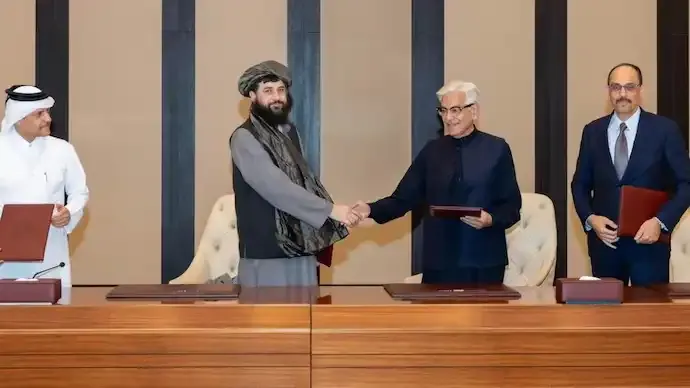
The fragile peace process between Afghanistan and Pakistan has collapsed after Islamabad made a controversial demand that Kabul take responsibility for Pakistan’s internal security—a condition the Taliban dismissed as “beyond capacity.” The breakdown of talks threatens to inflame already volatile tensions along the two countries’ 2,600-kilometre border.
The negotiations, held in Istanbul, were aimed at preventing further border clashes and sustaining the ceasefire signed in Doha last month, but ended without any agreement. Taliban spokesperson Zabihullah Mujahid confirmed the failure of talks on Saturday, stressing that while the Taliban would continue to honour the ceasefire, it would not accept “unrealistic expectations” from Pakistan.
“The ceasefire has not been violated by us so far, and it will continue to be observed,” Mujahid said, adding that Islamabad’s demand effectively sought to shift responsibility for Pakistan’s domestic insurgencies onto Afghanistan’s leadership.
Islamabad’s Unyielding Position
Pakistani Defence Minister Khawaja Muhammad Asif said on Friday that talks failed because Kabul refused to curb militant groups allegedly using Afghan soil to attack Pakistan. “The ceasefire will continue as long as no attacks originate from Afghanistan,” he stated, indirectly accusing the Taliban of harbouring militants linked to the Tehrik-i-Taliban Pakistan (TTP) — a banned outfit responsible for numerous attacks in Pakistan’s Khyber Pakhtunkhwa province.
Sources close to the negotiation process told India Today that Pakistan’s proposal included a clause demanding Afghanistan “guarantee the dismantling of all anti-Pakistan networks,” effectively giving Islamabad the right to monitor Afghan security operations. The Taliban delegation reportedly walked out after deeming the condition “unacceptable and impractical.”
Violence Erupts Amid Diplomacy
The talks’ collapse coincided with fresh border skirmishes between Afghan and Pakistani troops on Thursday, highlighting the fragility of the truce. According to local reports, both sides exchanged heavy gunfire near the Spin Boldak–Chaman crossing, a key trade route. No casualties were officially confirmed, but the incident underscored how thin the line between diplomacy and confrontation has become.
Turkey Steps In
Turkish President Recep Tayyip Erdogan met Pakistan’s Prime Minister Shehbaz Sharif in Baku on Saturday, expressing hope that the peace process could be revived. “Turkey remains committed to facilitating dialogue between our Muslim brothers,” Erdogan said, according to an official statement. Ankara has positioned itself as a mediator in South Asian security talks since the Taliban’s return to power in 2021.
A Relationship in Free Fall
Once regarded as allies, Pakistan and the Taliban have seen relations deteriorate sharply. Islamabad, which was instrumental in facilitating the Taliban’s 2021 takeover, now accuses Kabul of failing to prevent cross-border terrorism. The Taliban, in turn, blames Pakistan’s airstrikes and heavy-handed tactics for violating Afghan sovereignty.
Last month’s Pakistani air raids on Kabul and Nangarhar—targeting TTP leaders—killed dozens and drew sharp condemnation from the Taliban’s foreign ministry. The retaliatory clashes along the border marked the worst escalation since 2021.
Regional Fallout
Analysts warn that the collapse of talks could destabilise South Asia’s already fragile security landscape. With Afghanistan’s economy still reeling and Pakistan facing political turmoil, both nations risk plunging into a new cycle of conflict that could spill over into neighbouring regions.
As one senior Afghan official put it, “The talks in Istanbul were supposed to open a door. Instead, they’ve closed the last window of trust between two countries that share more than a border—they share history, refugees, and blood.”
Prev Article
Syrian President Ahmed al-Sharaa Arrives in US for Historic Meeting with Donald Trump After Delisting
Next Article
BBC Leadership Crisis: Tim Davie and Deborah Turness Resign Amid Trump Documentary Scandal