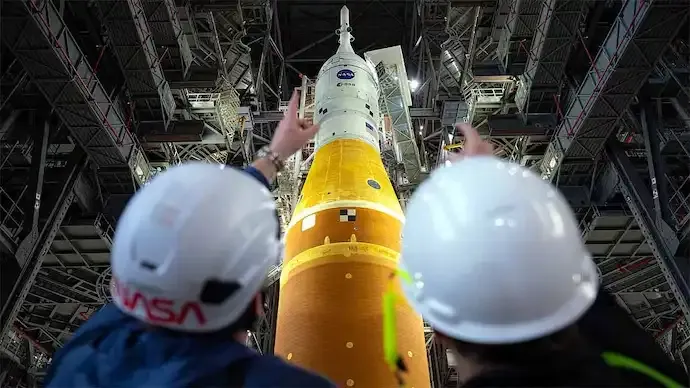
NASA has delayed the highly anticipated Artemis II mission, pushing the launch window to at least March 2026 after engineers detected a liquid hydrogen leak during a major fueling rehearsal. The mission, designed to send four astronauts on a historic journey around the Moon and back, is set to be the first crewed flight under the Artemis program. However, a tiny but powerful molecule — hydrogen — has once again emerged as one of the biggest engineering hurdles facing the space agency’s return to deep space exploration.
The delay follows a 49-hour launch countdown rehearsal at the Kennedy Space Center, where teams simulated real mission conditions to validate systems before liftoff. During the process, engineers observed issues related to hydrogen fueling interfaces, prompting NASA to halt the timeline and reassess safety protocols. The Space Launch System (SLS) rocket, which powers Artemis missions, relies on liquid hydrogen and liquid oxygen to achieve the extreme efficiency needed for lunar travel.
Hydrogen’s properties make it both an ideal rocket fuel and a persistent engineering challenge. As the smallest element in the universe, hydrogen can escape through microscopic gaps in seals or valves that would easily contain other propellants. Even tiny scratches, debris or slight misalignments in equipment can create leak paths. NASA officials have previously acknowledged that handling hydrogen requires extraordinary precision, especially in Florida’s humid launch environment where temperature changes can add stress to hardware.
The problem is not entirely new. Similar hydrogen leak issues caused delays during the uncrewed Artemis I mission in 2022. While that mission ultimately launched successfully, it exposed the complexity of managing cryogenic fuels in real-world conditions. Engineers have since adopted more aggressive testing methods, studying how sensitive components react to different pressures and temperatures. Despite those efforts, the latest rehearsal demonstrated that real launch conditions can still present unexpected obstacles.
NASA continues to rely on hydrogen because of its unmatched performance advantages. When combined with liquid oxygen, it produces extremely high exhaust speeds, delivering greater thrust efficiency — a critical requirement for missions carrying astronauts beyond Earth’s orbit. For deep-space travel, especially lunar exploration, no other chemical fuel currently offers the same balance of power and efficiency.
However, the presence of astronauts on Artemis II raises the stakes significantly. Safety standards are far stricter for crewed missions, meaning even minor uncertainties in fueling systems can lead to postponements. Engineers are now focused on diagnosing the exact cause of the leak, adjusting hardware where necessary and ensuring that every system performs flawlessly before another launch attempt.
Despite the delay, the Artemis program remains a cornerstone of NASA’s long-term plans to establish a sustained human presence on the Moon and prepare for future missions to Mars. The challenges posed by hydrogen highlight the delicate balance between pushing technological boundaries and maintaining absolute safety in human spaceflight.
As engineers continue refining the SLS rocket and fueling systems, the Artemis II mission stands as a reminder that even the smallest elements in the universe can shape the timeline of humanity’s next giant leap into space.
Prev Article
Anthropic AI Tools Trigger Global Tech Sell-Off, Indian IT Stocks Slide Amid Automation Fears
Next Article
Anthropic Claude Cowork Explained: AI Tool That Triggered Selloff in Infosys, TCS and SaaS Stocks