Shopping cart
Your cart empty!


Your cart empty!
Terms of use dolor sit amet consectetur, adipisicing elit. Recusandae provident ullam aperiam quo ad non corrupti sit vel quam repellat ipsa quod sed, repellendus adipisci, ducimus ea modi odio assumenda.
Lorem ipsum dolor sit amet consectetur adipisicing elit. Sequi, cum esse possimus officiis amet ea voluptatibus libero! Dolorum assumenda esse, deserunt ipsum ad iusto! Praesentium error nobis tenetur at, quis nostrum facere excepturi architecto totam.
Lorem ipsum dolor sit amet consectetur adipisicing elit. Inventore, soluta alias eaque modi ipsum sint iusto fugiat vero velit rerum.
Sequi, cum esse possimus officiis amet ea voluptatibus libero! Dolorum assumenda esse, deserunt ipsum ad iusto! Praesentium error nobis tenetur at, quis nostrum facere excepturi architecto totam.
Lorem ipsum dolor sit amet consectetur adipisicing elit. Inventore, soluta alias eaque modi ipsum sint iusto fugiat vero velit rerum.
Dolor sit amet consectetur adipisicing elit. Sequi, cum esse possimus officiis amet ea voluptatibus libero! Dolorum assumenda esse, deserunt ipsum ad iusto! Praesentium error nobis tenetur at, quis nostrum facere excepturi architecto totam.
Lorem ipsum dolor sit amet consectetur adipisicing elit. Inventore, soluta alias eaque modi ipsum sint iusto fugiat vero velit rerum.
Sit amet consectetur adipisicing elit. Sequi, cum esse possimus officiis amet ea voluptatibus libero! Dolorum assumenda esse, deserunt ipsum ad iusto! Praesentium error nobis tenetur at, quis nostrum facere excepturi architecto totam.
Lorem ipsum dolor sit amet consectetur adipisicing elit. Inventore, soluta alias eaque modi ipsum sint iusto fugiat vero velit rerum.
Do you agree to our terms? Sign up
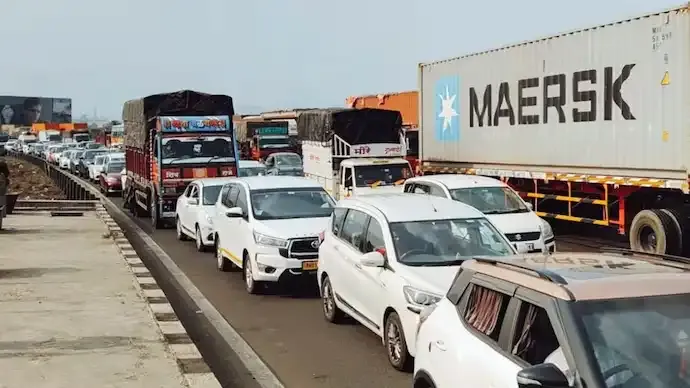
Traffic movement has finally resumed on the Mumbai-Pune Expressway after a nearly 32-hour standstill triggered by an overturned gas tanker in the Khandala Ghat stretch. Despite the reopening, congestion continues across long sections of the highway as authorities work to clear a backlog of vehicles stranded for almost two days.
Officials confirmed that the damaged tanker, which was carrying highly flammable propylene gas, was removed during early morning operations, allowing both Pune-bound and Mumbai-bound lanes to reopen. However, the prolonged shutdown led to vehicle queues stretching up to 20–22 kilometres at several points, leaving hundreds of commuters trapped overnight inside their cars.
Many drivers, exhausted after hours of waiting, had fallen asleep in their vehicles when traffic began moving again. Highway police teams have since been moving along the expressway, knocking on car windows to wake stranded motorists and gradually restore the flow of vehicles. Authorities said that normal traffic conditions may take several more hours to stabilise, especially near Lonavala where congestion remains heavy.
The incident began when a tanker reportedly lost control on a steep slope and overturned in the Khandala Ghat section, causing a gas leak and prompting immediate closure of the Mumbai-bound carriageway for safety reasons. Emergency teams prioritised securing the area and preventing any ignition risk before attempting recovery operations. The presence of hazardous material meant that authorities had to proceed cautiously, extending the duration of the closure.
Drone visuals captured during the incident showed long lines of vehicles stretching across the highway, highlighting the scale of disruption on one of India’s busiest express corridors connecting Mumbai and Pune. Within Pune district limits, several motorists remained stranded overnight, while alternate routes also experienced heavy pressure due to diverted traffic.
Commuters described the situation as extremely challenging, with many spending hours without access to food, drinking water, or basic facilities. Families travelling with children and elderly passengers were among those caught in the jam, prompting criticism over emergency management and preparedness on major highways.
Multiple agencies were deployed to handle the crisis, including disaster response teams, highway patrol units, and technical experts who worked together to safely transfer the gas and remove the tanker using heavy cranes. Authorities stressed that safety protocols were followed strictly to prevent any explosion risk during the recovery process.
Although traffic has resumed, officials warned that residual congestion could continue as stranded vehicles slowly disperse from affected stretches. Police have advised commuters to check traffic updates before travelling and consider alternative routes until the situation fully normalises.
The incident has once again drawn attention to the challenges of managing hazardous cargo on high-speed expressways and the need for stronger emergency response systems to minimise prolonged disruptions. As traffic gradually clears, authorities are expected to review safety measures and contingency planning to avoid similar large-scale gridlocks in the future.
78
Published: Feb 05, 2026

All India Story is your trusted source for comprehensive and up-to-the-minute news coverage across India. Bringing you the latest on politics, business, technology, entertainment, sports, and more, we are dedicated to keeping you informed with accurate, engaging, and insightful stories from every corner of the nation.