
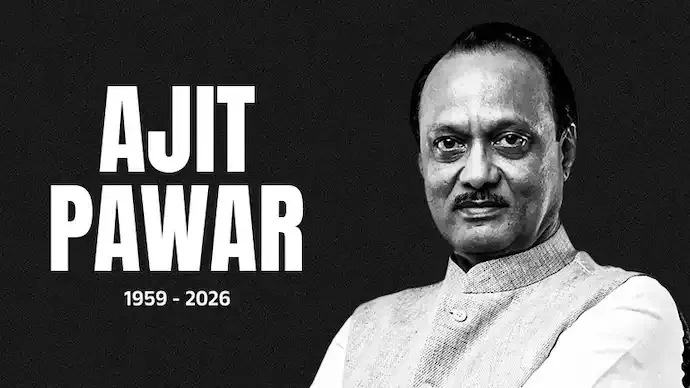
The death of Maharashtra Deputy Chief Minister Ajit Pawar in a charter aircraft crash near Baramati has brought an abrupt end to the career of one of the state’s most influential and unconventional political figures. Widely known as “Ajit Dada,” Pawar was a mass leader whose political life was defined by pragmatism, shifting alliances, and an unrelenting focus on power, administration, and grassroots control rather than ideological permanence.
Born on July 22, 1959, in Deolali Pravara in Ahmednagar district, Ajit Pawar grew up in a family deeply entrenched in Maharashtra’s cooperative and political ecosystem. His entry into public life was shaped early by personal loss; his father passed away when he was just 18. Pawar subsequently followed the political path carved by his uncle Sharad Pawar, one of the most prominent figures in Indian politics.
Pawar’s political grounding came not from legislative halls initially, but from the cooperative movement of western Maharashtra. In 1982, he began his public career by getting elected to the board of a sugar cooperative, an institution that plays a decisive role in the region’s politics. Over the years, he built an extensive network through sugar factories, milk unions, and cooperative banks—structures that later became the backbone of his political dominance.
In 1991, Pawar became chairman of the Pune District Cooperative Bank, a position he held for 16 years, further consolidating his influence in financial and rural institutions. That same year marked his formal electoral breakthrough when he was elected to the Lok Sabha from Baramati. However, he soon vacated the seat to shift to state politics, winning the Baramati Assembly constituency—a seat he would go on to hold continuously for more than three decades.
Baramati remained Pawar’s unshakeable fortress. In November 2024, he won the seat for the eighth time, securing a victory margin exceeding one lakh votes, underscoring his enduring grip over the constituency.
Known for his administrative acumen, Pawar emerged as a key power centre in Maharashtra governance. He handled crucial portfolios such as finance, irrigation, water resources, and rural development, becoming deeply embedded in the state’s policy-making and bureaucratic machinery. Over multiple terms, he served as Deputy Chief Minister several times, making him one of the longest-serving leaders in that role.
His career was punctuated by dramatic political turns. In 2019, following a fractured mandate, Pawar briefly formed a government with Devendra Fadnavis in a surprise early-morning swearing-in that lasted just 80 hours. In July 2023, he engineered a split within the Nationalist Congress Party, marking a decisive and public rupture with Sharad Pawar. By December 2024, he was sworn in again as Deputy Chief Minister, an event many observers viewed as the consolidation of his dominance in Maharashtra politics.
Ajit Pawar’s political philosophy was simple and unapologetic: no permanent friends, no permanent enemies—only permanent interests. His ability to adapt, negotiate, and realign made him both formidable and controversial.
Survived by his wife and two children, Pawar leaves behind a legacy that will continue to shape Maharashtra’s political equations. His absence creates a significant vacuum in a state long governed by coalition dynamics, where his organisational strength and tactical instincts often determined the balance of power.




Conversation
Be kind and stay on topic. Comments are moderated; abuse, spam and personal attacks are removed. Report a problem