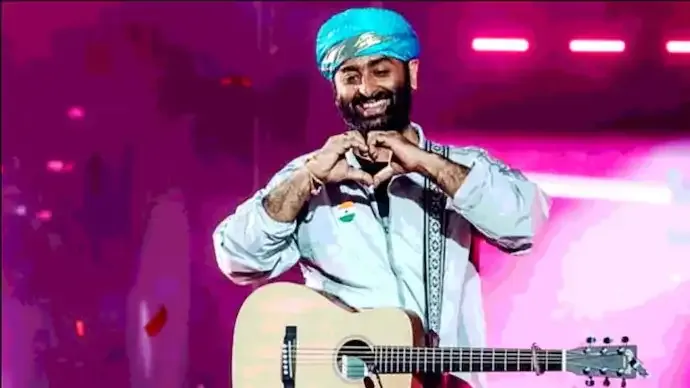
When Arijit Singh announced that he was stepping away from playback singing, the immediate reaction was confusion, followed by concern. Had one of India’s most prolific voices decided to retire? Was this exhaustion, disillusionment, or something deeper? A closer reading of his words offers clarity: this was not an exit from music, but a conscious disengagement from the playback system itself.
That distinction matters. Arijit Singh is not walking away because he lacks relevance, demand, or creative energy. At 38, with over 700 songs recorded across languages and a career that reshaped contemporary Hindi film music, his position in the industry remains unshaken. His journey—from an unassuming reality show contestant to the voice behind defining soundtracks of a generation—was never engineered by hype or privilege. It was earned slowly, patiently, and almost stubbornly.
So when someone with that standing chooses to step back, it is worth asking whether this is fatigue or clarity. Increasingly, it appears to be the latter.
Playback singing, as it exists today, is not merely about vocal ability. It is a system built on compliance, availability, and silence. Talent opens the door, but obedience keeps it open. Arijit Singh has never played comfortably within those boundaries. He has remained fiercely private in an industry that demands constant visibility. He avoids aggressive promotion, sidesteps award-season politics, and lets his music travel without the scaffolding of manufactured narratives.
His public presence has always been minimal, almost elusive. Concerts, not press circuits, are where he communicates. Songs, not soundbites, are how he speaks. That refusal to conform has often made him an anomaly in an ecosystem that thrives on access and control.
Even when he once publicly called out a powerful figure for sidelining his recorded work, it was not an act of rebellion for attention, but a rare assertion of self-respect. In an industry that normalises erasure and exploitation, that moment stood out not because it was loud, but because it was honest.
What makes Arijit’s decision particularly unsettling for the industry is that it does not read as failure. There is no scandal, no creative decline, no fading demand. Instead, there is autonomy. He is choosing to disengage not because he must, but because he can.
This is not the story of an artist trying to fix a broken system or martyr himself for reform. There is no grand announcement of change, no call for collective uprising. It is quieter, and perhaps more radical than that. He is simply refusing the job. Refusing to participate in structures that no longer align with his values or protect his mental and creative well-being.
In a profession where longevity is often earned through endurance rather than dignity, that refusal becomes a statement. It suggests that an artist does not need institutional approval to remain relevant, nor permission to exist meaningfully.
Arijit Singh has not said what comes next, and he does not need to. Music, after all, is not owned by systems; it is created by individuals. His voice will continue to exist wherever he chooses to place it—outside rigid frameworks, beyond dictated formats, and free from compliance-driven expectations.
He has not walked away from music. He has walked away from a system that forgot music is created, not managed. And in doing so, he may have quietly redefined what artistic power looks like in an industry built on control.
Prev Article
Border 2 Review: When Emotion Leads and Strategy Takes a Back Seat
Next Article
Border 2 Falls Short of Honouring the Armed Forces Despite Emotional Legacy