
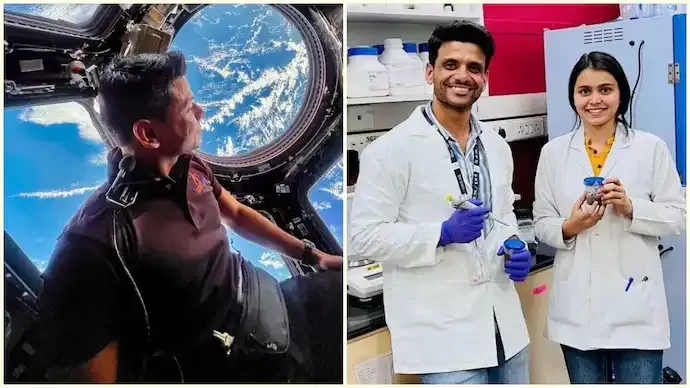
India’s space ambitions are now extending beyond rockets and missions into the realm of planetary construction. A new scientific study has revealed that bacteria found in Bengaluru’s soil could play a crucial role in building durable structures on Mars. The research, co-authored by Indian astronaut Shubhanshu Shukla, explores how microbes behave under Martian soil conditions and how they could be used to manufacture so-called “space bricks” using local resources.
The study was led by scientists at the Indian Institute of Science and has been published in the peer-reviewed journal PLOS One. It addresses one of the most pressing challenges for long-term human presence on Mars: construction without relying on materials transported from Earth.
Transporting building material across millions of kilometres is impractical and expensive. As a result, future missions will need to depend on in-situ resource utilisation — using what is already available on the planet’s surface. Previous experiments had demonstrated that certain Earth-based bacteria can bind soil particles together, forming brick-like structures through a process known as biocementation. However, Mars presents an additional complication: the presence of perchlorates.
Perchlorates are toxic, chlorine-based compounds found in Martian soil at concentrations of up to one per cent. These chemicals pose serious risks to both humans and microorganisms. The latest study set out to examine whether bacteria could survive, and function effectively, in such hostile conditions.
In earlier work, researchers used the bacterium Sporosarcina pasteurii, which produces calcium carbonate when mixed with urea and calcium. This calcium carbonate acts as a natural cement, binding soil particles together. Guar gum, a plant-derived polymer, was added to strengthen adhesion and improve bacterial survival.
In the new research, the team introduced a more resilient bacterial strain isolated from Bengaluru soil and exposed it to perchlorate-rich conditions similar to those found on Mars. While the chemical slowed bacterial growth and caused cellular stress, it produced an unexpected result: stronger bricks.
Under stress, the bacteria altered their behaviour. They changed shape, clustered together and secreted larger quantities of extracellular matrix — a network of proteins and molecules that help cells stick together. High-resolution electron microscopy revealed that this matrix formed microscopic bridges between bacterial cells and calcium carbonate deposits, reinforcing the overall structure of the bricks.
When perchlorate was added to Martian soil simulants along with guar gum and a nickel chloride catalyst, the resulting bricks were significantly more robust than those produced without the chemical. The findings suggest that stress conditions, when carefully managed, can actually enhance the biocementation process.
Shukla, who is currently pursuing his master’s degree at IISc alongside astronaut training, says the research has practical implications for future missions. Constructing landing pads, roads and habitats using locally produced materials could reduce costs and improve safety. Uneven terrain has already contributed to failures in lunar landings, underlining the need for stable infrastructure beyond Earth.
The study marks Shukla’s entry into published scientific research and reflects a broader shift in India’s space programme. Indian astronauts are not only preparing for missions but are also contributing to the scientific groundwork that could enable sustained human presence on the Moon and Mars.
As space agencies worldwide plan for long-duration missions, the idea that bacteria from Earth’s soil could help humans build on another planet underscores how biology, engineering and exploration are increasingly converging.





Conversation
Be kind and stay on topic. Comments are moderated; abuse, spam and personal attacks are removed. Report a problem