



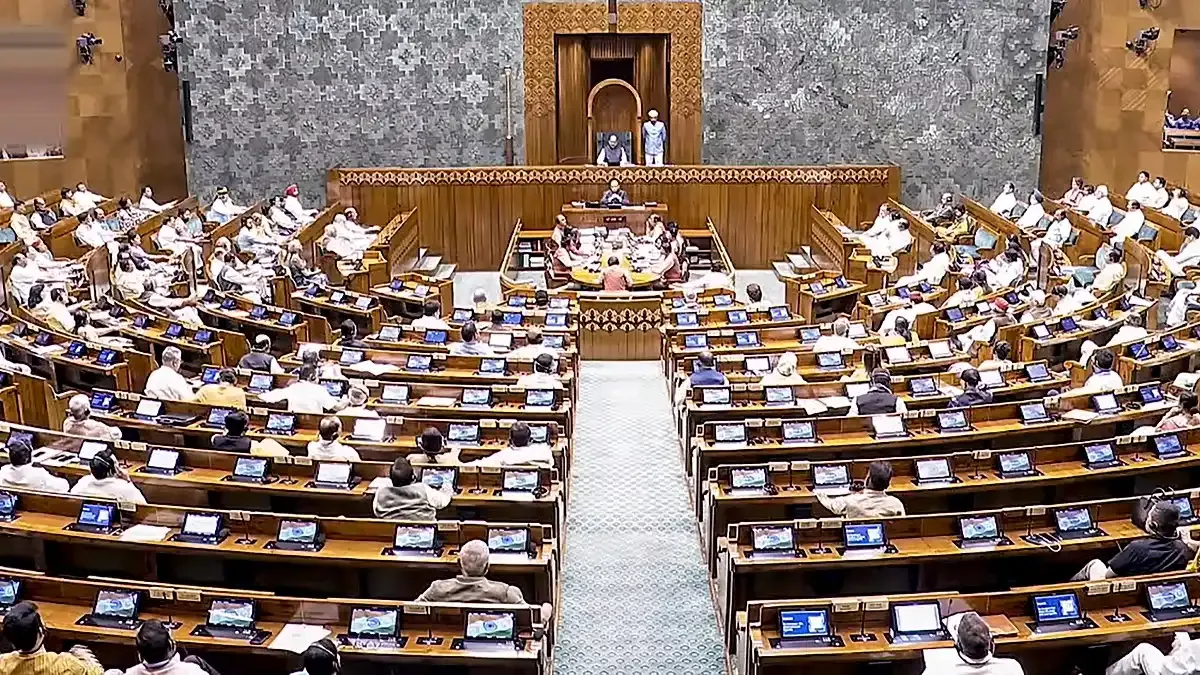
The Budget Session 2026 of the Indian Parliament formally began on Tuesday with Draupadi Murmu addressing a joint sitting of the Lok Sabha and Rajya Sabha. The session marks the start of a crucial legislative period ahead of the presentation of the Union Budget and comes amid heightened political engagement between the government and opposition parties.
President Murmu began her address at 11 am, outlining the government’s vision for India’s growth trajectory and reflecting on the country’s progress over the past decade. She said that India has strengthened its foundation across sectors, ranging from infrastructure and welfare to governance and economic resilience. According to the President, the country has now entered the second phase of the 21st century, with the first 25 years marked by significant achievements and transformative experiences.
In her speech, the President highlighted that the last 10 to 11 years have played a defining role in reinforcing India’s institutional and economic base. She described 2026 as a pivotal year in India’s journey towards the goal of becoming a developed nation, stressing that the coming period would be critical for long-term national growth.

President Murmu also expressed gratitude for the opportunity to address Parliament and reflected on milestones of national pride. She referred to the nationwide observance marking 150 years of “Vande Mataram” and acknowledged the cultural and historical significance of the occasion. She congratulated lawmakers for holding a special parliamentary discussion to commemorate the legacy of Bankim Chandra Chatterjee and the enduring inspiration of the national song.
During her address, the President praised key welfare initiatives undertaken in recent years, noting that schemes aimed at healthcare access, social security, and financial inclusion have benefited millions of citizens. She said that targeted programmes for marginalised sections have played a vital role in improving living standards and expanding access to essential services. Alongside welfare, she underlined the importance of infrastructure development, citing advances in transport connectivity and public systems.
The President also spoke about governance reforms and emphasised the importance of transparency and accountability in public administration. She said sustained efforts have been made to strengthen systems, promote efficiency, and reduce corruption, contributing to greater public trust in institutions.
As the Budget Session began, political activity was visible across party lines. Opposition parties convened a meeting ahead of the session to finalise their strategy. Several opposition groups have sought discussions on legislative and administrative matters, including the implementation of the Special Intensive Revision and the VB-G RAM-G Bill. However, the government has maintained that these topics were addressed in earlier sessions and has indicated that fresh debates on them are unlikely.
Union ministers reiterated that the focus of the session would remain on budgetary business and legislative priorities. After the opening day, attention is expected to shift to the presentation of the Economic Survey, which is scheduled to be tabled in Parliament on Wednesday. The survey is anticipated to provide an overview of the economy’s performance and set the context for the Union Budget.
The Budget Session is seen as particularly significant, as it will shape fiscal policy discussions at a time when economic growth, employment, infrastructure spending, and social welfare remain central to public discourse. With multiple parties preparing to raise issues and the government outlining its development roadmap, the session is expected to witness intense debate in the days ahead.





Conversation
Be kind and stay on topic. Comments are moderated; abuse, spam and personal attacks are removed. Report a problem