
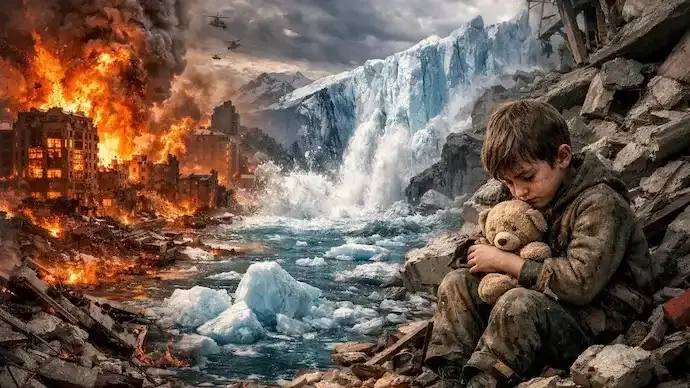
Humanity has achieved remarkable milestones—from decoding DNA to exploring space and advancing artificial intelligence. Yet, despite these breakthroughs, the world continues to face repeated cycles of conflict and environmental destruction.
The ongoing tensions in West Asia, particularly around the Strait of Hormuz, have once again exposed a troubling contradiction: while humans possess the intelligence to understand the consequences of their actions, they often fail to act responsibly.
War and Environmental Risk Collide
The current conflict has not only raised geopolitical concerns but also highlighted severe environmental risks. The Strait of Hormuz, one of the world’s most critical oil transit routes, is now at the center of potential ecological disaster.
Environmental groups such as Greenpeace Germany have warned that any major oil spill in the region could become an ecological catastrophe.
A Ticking Ecological Time Bomb
Simulations suggest that a large-scale oil spill in the region could devastate marine ecosystems, including coral reefs, mangrove forests, and seagrass meadows. These ecosystems are vital for biodiversity, climate regulation, and coastal protection.
The destruction of such natural systems would have long-term consequences not only for the environment but also for human livelihoods that depend on them.
Human Intelligence vs Human Action
Humans are unique in their ability to understand long-term consequences. Scientific research has already established the risks of climate change, pollution, and ecological imbalance.
Despite this awareness, global actions often contradict this knowledge. Conflicts continue, fossil fuel dependence remains high, and environmental protection takes a back seat during crises.
The Cost of Short-Term Thinking
One of the biggest challenges highlighted by the current situation is short-term decision-making. Immediate political or economic goals often overshadow long-term environmental sustainability.
This approach increases the risk of irreversible damage, as ecosystems once destroyed may take decades—or even centuries—to recover.
Global Impact Beyond Conflict Zones
The environmental risks associated with the Hormuz region are not limited to the Middle East. Oil spills and disruptions in marine ecosystems can have global consequences, affecting climate patterns, marine life, and food chains worldwide.
This interconnected impact shows how local conflicts can escalate into global environmental crises.
A Wake-Up Call for Collective Responsibility
The current situation serves as a reminder that technological advancement alone cannot ensure a sustainable future. Responsible decision-making and global cooperation are equally important.
Addressing climate risks requires a shift in priorities—from conflict-driven actions to long-term environmental protection.
Rethinking the Future
As the world watches the unfolding crisis, it becomes clear that humanity stands at a critical crossroads. The ability to innovate must be matched with the willingness to preserve.
The question is no longer about what humans can achieve, but whether they can act wisely enough to protect the only planet they have.






Conversation
Be kind and stay on topic. Comments are moderated; abuse, spam and personal attacks are removed. Report a problem