

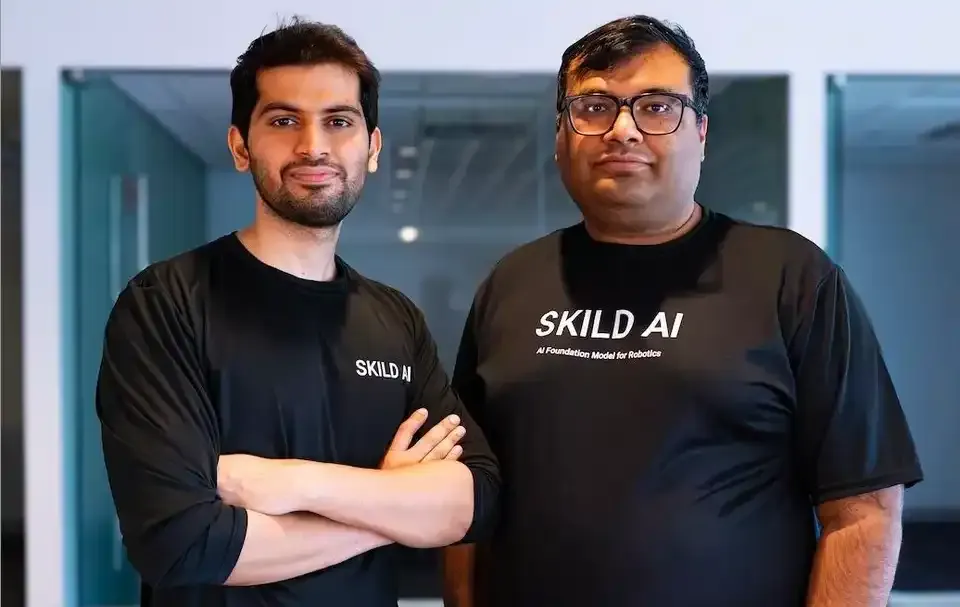

Robotics is standing at the edge of a major transformation, according to Deepak Pathak, CEO and co-founder of Skild AI, who says the biggest limitation holding robots back for decades has finally found a solution — intelligence.
Speaking to India Today on the sidelines of the World Economic Forum, Pathak said Skild AI is focused on building what he describes as the “brain” for robots — a missing layer of cognition that has prevented machines from performing even simple real-world tasks reliably.
“For decades, robots had bodies, sensors and motors, but they didn’t have a brain,” Pathak said. “That’s why something as basic as opening a door in an unfamiliar environment was still extremely difficult.”

According to Pathak, traditional robotics relied heavily on hard-coded instructions and structured environments, making machines brittle and unreliable outside controlled factory floors. What Skild AI is building, he explained, is a general-purpose intelligence layer that allows robots to understand, reason and adapt to the physical world in real time.
This shift, he said, marks a fundamental change in robotics — moving away from scripted automation toward learning-based systems that can operate across diverse environments.
Addressing concerns around job losses due to automation, Pathak offered a more nuanced view. He acknowledged that countries like India still have a labour surplus, but stressed that this is not the global reality.
“Many parts of the world, especially Japan and South Korea, are facing a shrinking workforce,” he said. “They are staring at millions of unfilled jobs, particularly in manufacturing, logistics and elder care. Automation is no longer optional there — it’s a necessity.”
Pathak emphasised that Skild AI’s mission is not to replace human workers, but to bridge the widening gap between labour demand and availability. As populations age and workforce participation declines in several advanced economies, intelligent robots could help sustain productivity and economic growth.
India, he believes, is uniquely positioned to play a central role in this global robotics shift. Pathak confirmed that Skild AI has already set up operations in Bengaluru, tapping into the country’s deep pool of engineering and AI talent.
Beyond software expertise, Pathak highlighted India’s strength in hardware ecosystems. “India already has strong automotive and electronics manufacturing supply chains,” he said. “If we combine that with advanced AI-driven robotics, India can leapfrog many countries rather than follow them.”
He argued that robotics success will increasingly depend on tight integration between AI models, hardware design and manufacturing scale — an area where India has the potential to build end-to-end capabilities.
Looking ahead, Pathak said the next decade will define how robots integrate into everyday life. With intelligent “brains” finally becoming viable, machines could soon perform complex tasks in homes, warehouses, hospitals and public infrastructure — not as replacements for humans, but as collaborators filling roles that can no longer be staffed.
“The goal is not fewer humans working,” he said. “The goal is making sure the world keeps running when humans alone are no longer enough.”






Conversation
Be kind and stay on topic. Comments are moderated; abuse, spam and personal attacks are removed. Report a problem