

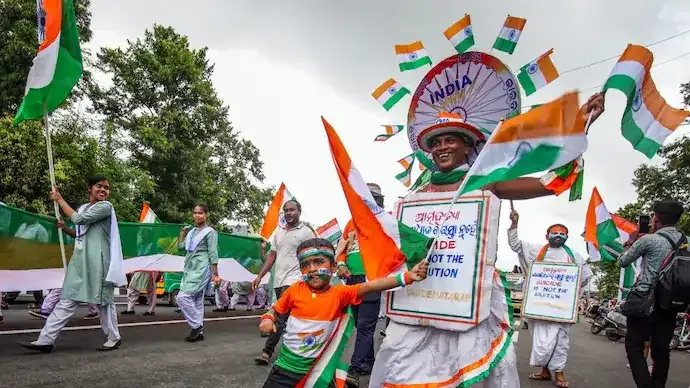

The Union Home Ministry has issued fresh ceremonial guidelines making the national song Vande Mataram mandatory at designated government functions across the country. The directive outlines when and how the song should be performed during official state occasions, aiming to standardise protocol at public events attended by senior constitutional authorities.
According to the new guidelines, a six-stanza rendition of Vande Mataram, lasting approximately three minutes and ten seconds, will be played or sung during significant ceremonies. These include events involving the unfurling of the national flag, civilian honours functions such as the Padma Awards, and formal programmes attended by the President, where the song will be performed both at arrival and departure.
The ministry has also clarified the sequence to be followed when both the national song and the national anthem Jana Gana Mana are part of the ceremony. In such cases, Vande Mataram will be rendered first, followed by the national anthem, which traditionally lasts 52 seconds. The guidelines further specify that the sound of the mridangam will precede the playing of the anthem during official observances.

Officials stated that standing during Vande Mataram will be mandatory at government functions to maintain uniformity in ceremonial conduct. However, the directive makes it clear that this requirement does not extend to entertainment venues such as cinema halls. Educational institutions have also been advised to begin the school day with the national anthem as part of broader efforts to reinforce national symbols in public life.
The decision comes shortly after Narendra Modi launched a year-long nationwide commemoration marking 150 years of Vande Mataram. The programme, which runs from November 2025 to November 2026, celebrates the historic significance of the song, composed by Bankim Chandra Chatterji in 1875. Over the decades, Vande Mataram has become a powerful symbol of India’s freedom movement and national identity.
Government officials said the updated protocol is intended to ensure consistency in ceremonial practices across ministries, state governments, and public institutions. Detailed instructions regarding the approved version, duration, and sequence have been circulated to relevant authorities to avoid variations in performance during official events.
The announcement has also sparked political debate, with discussions taking place in Parliament regarding the role of national symbols and the implementation of such guidelines. Supporters argue that the move strengthens cultural heritage and patriotic traditions, while critics have called for clarity on practical implementation in diverse settings.
As the new protocol comes into effect, government departments and institutions are expected to align their event planning with the revised guidelines, ensuring that ceremonial observances involving national symbols follow a uniform and clearly defined structure across the country.







Conversation
Be kind and stay on topic. Comments are moderated; abuse, spam and personal attacks are removed. Report a problem