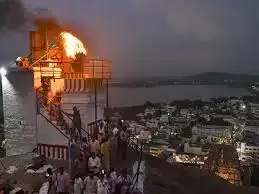
The Tamil Nadu government has faced a significant legal setback after the High Court permitted the lighting of Deepam on a hilltop in Madurai, putting an end to days of uncertainty surrounding the ritual. The ruling has brought renewed focus on the sensitive intersection of religion, administration and law in the state, while also triggering sharp political reactions.
A division bench of the Madras High Court upheld an earlier order passed by a single judge, allowing the traditional lighting of Holi Deepam at the hilltop site. The court’s decision effectively cleared the way for the ritual to proceed, rejecting the objections raised by the state administration. The verdict is being widely viewed as a setback for the government led by M K Stalin, which had opposed the event citing law and order concerns and the sensitive religious nature of the location.
The controversy centres on a hill in Madurai where the Deepam lighting ritual is traditionally performed. The site is also in close proximity to the Sikandar Dargah, where a separate religious ritual and chariot festival are currently underway. The closeness of the two religious landmarks had raised administrative concerns over crowd control, security and the potential for communal tension.
Despite these concerns, the High Court ruled that the Deepam ritual could not be denied merely on apprehensions, particularly when the practice has historical and cultural significance. The bench observed that constitutional protections guarantee the right to practice religion, subject to reasonable restrictions, and noted that the administration has the responsibility to ensure adequate security rather than impose a blanket prohibition.
Following the ruling, the Sikandar Dargah ritual continued with certain curbs in place, as authorities deployed security personnel to manage the situation. Officials indicated that precautionary measures had been put in place to prevent any untoward incidents, including regulated access routes and monitoring of crowd movement.
The court’s order has also intensified the political discourse in Tamil Nadu. The Bharatiya Janata Party accused the state government of adopting an “anti-Sanatan” stance and argued that the opposition to the Deepam ritual reflected selective interference in religious practices. Party leaders welcomed the court’s intervention, calling it a reaffirmation of religious freedom and constitutional values.
The ruling has sparked broader debate on how governments should navigate disputes involving overlapping religious traditions and shared spaces. Legal experts note that the judgment reinforces the principle that administrative convenience cannot override established religious practices unless there is clear and present danger to public order.
For the state government, the decision underscores the challenges of balancing secular governance with deeply rooted cultural traditions. While officials have maintained that their actions were driven by security considerations, the court’s observations have placed the onus back on the administration to facilitate peaceful conduct of rituals rather than restrict them.
As Deepam lighting proceeds under the court’s protection, the episode is expected to have lasting political and social implications in Tamil Nadu. It highlights the continuing sensitivity around religious issues and the judiciary’s role in adjudicating disputes that carry both cultural and political weight.
Prev Article
Advanced GDP Estimates Today: AI Skilling Push and Trump Tariff Refund Shape Market Focus
Next Article
India Fast-Tracks Chenab Hydropower Projects After Indus Waters Treaty Pause