
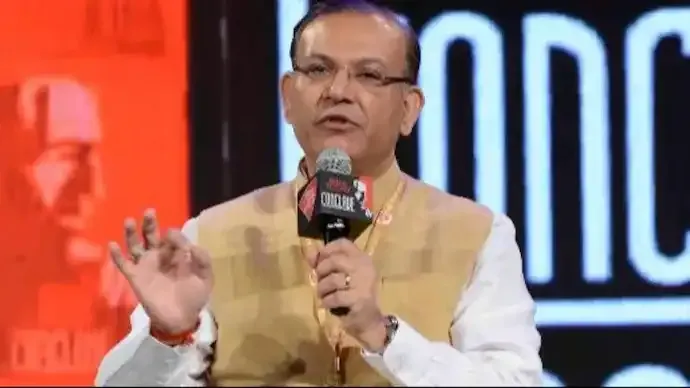
India’s true economic competition lies not with other developing nations but with the world’s two largest advanced economies—the United States and China, according to Jayant Sinha. He said that for India to close the widening gap, future policy—especially the Union Budget 2026—must place education, productivity and technological capability at its core.
Speaking on India’s long-term growth strategy, Sinha argued that India should benchmark itself only against the most advanced economies. “We are moving ahead of everyone else, so our competition is actually America and China,” he said, stressing that Indian workers must become significantly more productive and better skilled to succeed in this race.
To underline the challenge, Sinha cited the economic output of the United States. With a population of roughly 350 million, the US produces nearly $30 trillion in gross domestic product, translating into per-capita income levels close to $93,000 annually. That scale of prosperity, he said, is not accidental but the result of decades of sustained investment in education, capital formation, modern tools and advanced technology.
India, by contrast, must now focus on replicating this productivity jump across its much larger workforce. According to Sinha, higher incomes will follow only if workers have access to better skills, modern equipment and cutting-edge technologies that dramatically raise output.
China’s rapid technological progress offers another stark comparison. Sinha pointed to the emergence of DeepSeek, an artificial intelligence model that rivals products developed by global leaders such as OpenAI and Anthropic. He said this demonstrated how quickly China can convert scale, capital and policy focus into globally competitive innovation. “It shows how innovative and productive they are,” he noted.
Against this backdrop, Sinha said Budget 2026 should be evaluated not merely on fiscal arithmetic but on whether it meaningfully strengthens India’s education ecosystem. He stressed the need for updated curricula aligned with future industries, widespread digital and technical skill development, and improved access to advanced computing, artificial intelligence tools and high-end equipment.
He also emphasised infrastructure and capital availability as critical enablers of productivity. Without reliable physical infrastructure, modern research facilities and affordable access to capital, India risks falling behind even as global competition intensifies.
According to Sinha, education is not just a social investment but a strategic economic necessity. Countries that dominate global value chains, he said, do so because their workforce is better trained, better equipped and more capable of innovating at scale.
Ultimately, Sinha argued that India’s economic ambitions will be realised only if its people can operate at the same level as their counterparts in advanced economies. “India’s race is now with the US and China,” he said, adding that closing the gap will require far stronger skills, infrastructure and technological depth than what currently exists.
As policymakers prepare the Union Budget 2026, Sinha’s remarks underscore a central message: without a decisive push on education and productivity, India’s aspirations of global leadership may remain out of reach.



Conversation
Be kind and stay on topic. Comments are moderated; abuse, spam and personal attacks are removed. Report a problem