

The year 2026 is shaping up to be a defining moment for global human spaceflight, as India and the United States prepare to execute two landmark missions that reflect contrasting yet complementary ambitions in space exploration. India’s Gaganyaan programme and the United States’ Artemis-II mission are set to expand humanity’s presence in space—one by strengthening access to low Earth orbit and the other by pushing astronauts back into deep space after more than half a century.
India’s human spaceflight programme, led by Indian Space Research Organisation, is moving closer to reality with the planned launch of its first uncrewed orbital test mission, Gaganyaan-G1, targeted for around March 2026. The mission will be carried aboard the human-rated LVM3 launch vehicle and will mark a major technical milestone in India’s efforts to independently send humans into space.
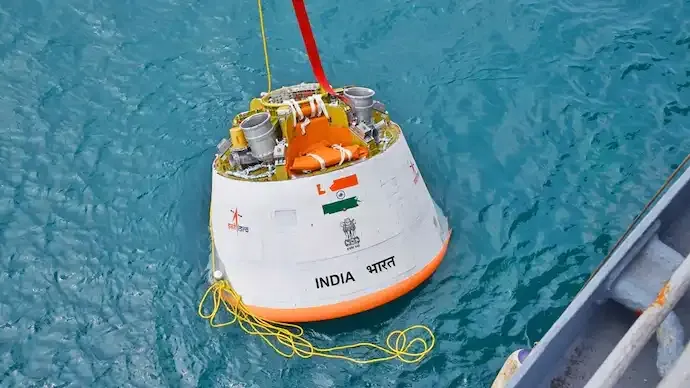
At the heart of the G1 mission will be Vyommitra, a humanoid robot designed to replicate key astronaut functions. Operating in low Earth orbit at an altitude of approximately 300–400 kilometres, the spacecraft will test vital crew systems, including life-support mechanisms, onboard controls, re-entry dynamics, and parachute-based splashdown recovery in the ocean. These systems must perform flawlessly before India undertakes its first crewed Gaganyaan mission later in the decade.
Beyond its immediate technical objectives, Gaganyaan represents a strategic leap for India. Success would place the country among a select group of nations capable of independently launching, sustaining, and safely returning humans from space. This capability reduces reliance on foreign partners and opens pathways for future initiatives such as an Indian space station, expanded scientific missions, and participation in the emerging global commercial human spaceflight market. Political backing for the programme has been visible at the highest levels, with Prime Minister Narendra Modi publicly engaging with astronaut candidates and underlining the mission’s national importance.
While India consolidates its presence in low Earth orbit, the United States is preparing to venture farther than humans have travelled since the Apollo era. The Artemis-II mission, led by National Aeronautics and Space Administration, is scheduled for no earlier than February 5, 2026. It will carry four astronauts on a roughly 10-day journey around the Moon, marking humanity’s first crewed mission beyond low Earth orbit since Apollo 17 in 1972.
Artemis-II will serve as a critical proving flight for NASA’s Space Launch System rocket and the Orion spacecraft. The crew is expected to travel more than 5,000 nautical miles beyond the Moon, testing deep-space navigation, radiation exposure management, long-distance communications, and long-duration life-support systems. The data gathered will be essential for future lunar landings under the Artemis programme and for longer-term ambitions, including crewed missions to Mars.
Together, Gaganyaan and Artemis-II highlight the arrival of a multipolar era in human spaceflight. As India strengthens independent access to near-Earth space and the United States leads a return to deep-space exploration with international partners, technological advances from these missions are likely to influence crew safety standards, spacecraft design, and mission operations worldwide. Their impact is expected to shape national space programmes, commercial spaceflight, and human exploration strategies well into the 2030s.



Conversation
Be kind and stay on topic. Comments are moderated; abuse, spam and personal attacks are removed. Report a problem