
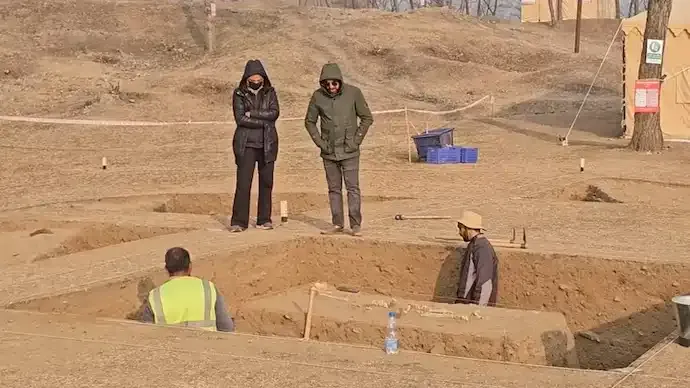
Recent archaeological excavations at Zehanpora have reaffirmed Kashmir’s ancient role as a major centre of Buddhist learning during the Kushan period. Yet, centuries after stupas rose along the Silk Route, the Valley witnessed one of the most dramatic political and religious transitions in its history — a shift from Hindu rule to Islamic governance, triggered not by an invader, but by a displaced Buddhist prince.
For centuries, Kashmir evolved from myth into monarchy. Ancient texts describe the Valley as once submerged under a vast lake, later transformed into fertile land through divine intervention. Over time, Kashmir emerged as an intellectual powerhouse, nurturing Hindu philosophy, Shaivism and Buddhism in parallel.
Buddhism took firm root in the Valley during the Mauryan era under Ashoka, while its global stature peaked under the Kushans. During the reign of Kanishka, Kashmir hosted the Fourth Buddhist Council, firmly establishing itself as a nerve centre of Mahayana thought.
The Valley later reached its imperial zenith under Lalitaditya, whose reign symbolised military power, architectural grandeur and political stability. But by the 12th century, the foundations of the kingdom had begun to crumble.
Internal decay weakened the state. Feudal lords grew stronger than kings, irrigation systems collapsed, and famine and violence became recurring features. Central authority eroded rapidly, leaving Kashmir vulnerable to external shocks.
That shock arrived in 1320, when Mongol forces swept through the Valley. The ruling monarch fled, leaving the population defenceless. Villages were destroyed, thousands were enslaved, and Kashmir emerged from the devastation leaderless and fractured.
Into this vacuum stepped three refugees — men without armies but with ambition. Among them was Rinchan, a Buddhist noble from Ladakh whose father had been killed in regional conflict. Rinchan did not arrive in Kashmir seeking a throne, but survival.
Amid chaos, Rinchan seized power through calculated force, eliminating the prime minister and declaring himself ruler. To legitimise his reign, he married Kota Rani, a symbol of Kashmir’s old Hindu order and political continuity.
Yet Rinchan remained an outsider. Aware of his fragile legitimacy, he sought conversion to Shaivism, hoping religious assimilation would secure acceptance. His request was rejected by the Brahmin priesthood, bound by rigid caste hierarchies that refused to elevate a foreign-born Buddhist to sacred kingship.
The rejection altered Kashmir’s destiny.
Rinchan turned instead to Bulbul Shah, embracing Islam and taking the name Sultan Sadr-ud-Din. With this act, he became Kashmir’s first Muslim ruler — not through conquest, but conversion.
His reign was brief and turbulent. Resistance from entrenched elites led to rebellion, and Rinchan suffered fatal injuries during an uprising. Before his death, however, he made a decisive political move, entrusting his wife and heir to his trusted minister Shah Mir.
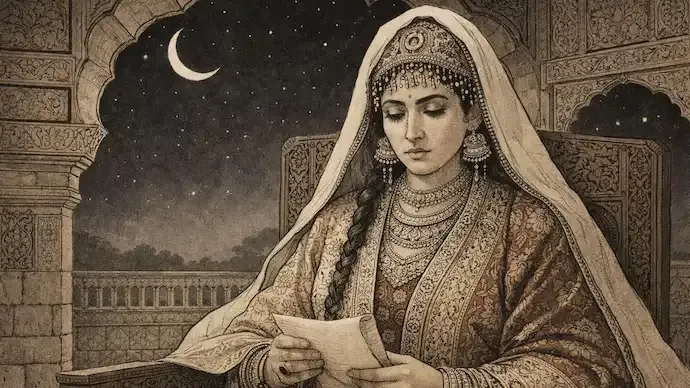
In the years that followed, Kota Rani ruled as regent and sovereign, navigating a Valley caught between collapsing traditions and emerging forces. She became the final Hindu ruler of Kashmir. Eventually, Shah Mir ascended the throne, founding the Shah Mir dynasty and firmly establishing Islamic rule in the Valley.
Rinchan’s legacy lies not in military conquest but in psychological transformation. His reign shattered the exclusivity of Brahmanical political power and demonstrated that authority in Kashmir could exist beyond rigid religious hierarchies. In doing so, a Buddhist refugee unknowingly opened the gates to a new era.
Kashmir’s transition to Islamic rule was thus not a sudden rupture, but the outcome of internal decay, social rigidity, refugee politics and one pivotal act of rejection — a moment that reshaped the Valley’s civilisational course forever.




Conversation
Be kind and stay on topic. Comments are moderated; abuse, spam and personal attacks are removed. Report a problem