

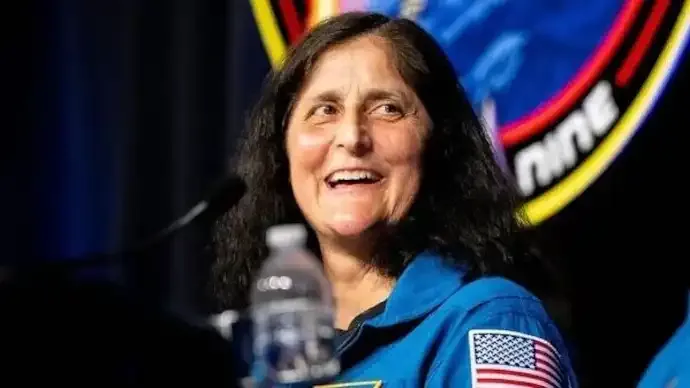

For decades, Sunita Williams has been one of the most recognisable faces of human spaceflight. With a record-setting career that saw her spend 608 days in space and command the International Space Station (ISS), Williams recently retired from NASA after 27 years of service. As she reflects on her extraordinary journey, the veteran astronaut has revealed that the foundation of her resilience and adaptability was laid much earlier — during her childhood.
Currently in India following her retirement, Williams spoke candidly about her early life in an unreleased podcast interview with entrepreneur Raj Shamani, explaining how her upbringing quietly shaped the astronaut she would one day become.
Growing Up in a Multicultural Household
Sunita Williams was raised in a household that blended cultures, traditions, and belief systems. Her father hailed from Gujarat, while her mother was Slovenian-American. As a child, this meant growing up with different cuisines, customs, and perspectives coexisting under one roof.

Reflecting on those early years, Williams said she did not fully understand the value of this diversity at the time. “It’s a big benefit. You don’t realise it when you’re a kid. It’s life, that’s how it is,” she recalled. Over time, she came to see that exposure to different cultures helped her develop patience, empathy, and the ability to relate to people from vastly different backgrounds.
According to Williams, this early appreciation of diversity played a crucial role in her professional life, particularly in space, where teamwork, understanding, and mutual respect are essential.
Learning Adaptability and Emotional Strength
Williams explained that growing up in a culturally rich environment taught her how to listen and adapt — skills that later became vital aboard the ISS. Life in space brings together astronauts from multiple countries, each with distinct working styles, languages, and cultural norms.
Her childhood experiences helped her navigate these environments with ease, allowing her to collaborate effectively with international crews and remain calm under pressure. “It set me up for success,” she noted, highlighting how emotional intelligence can be just as important as technical expertise in high-risk professions.
Childhood Lessons Tested in Space
Those early lessons were put to the ultimate test during Williams’ final space mission. Originally planned as a short mission lasting just over a week, it unexpectedly stretched beyond 90 days due to unforeseen technical and logistical challenges.
During that period, Williams found herself living aboard the ISS far longer than expected, cut off from Earth and operating in one of the most extreme environments humans can endure. Drawing on the patience, resilience, and adaptability she developed early in life, she navigated the extended mission without panic, eventually returning safely to Earth.
A Career Defined by Perseverance
Over her 27-year career, Williams broke multiple records, conducted numerous spacewalks, and served as ISS commander — a role that demands not only technical mastery but also emotional steadiness and leadership under isolation.
Her journey underscores an often-overlooked truth: astronauts are not shaped only by training programs and simulators, but also by the values and experiences they carry from childhood.
More Than an Astronaut
As Sunita Williams steps away from active duty, her story stands as a reminder that greatness is rarely built overnight. The curiosity, openness, and resilience she absorbed as a child ultimately enabled her to thrive in space, turning the vast vacuum of stars into a second home.
Her legacy goes beyond records and missions. It highlights how early exposure to diversity, empathy, and adaptability can shape individuals capable of extraordinary achievements — even beyond the boundaries of Earth.






Conversation
Be kind and stay on topic. Comments are moderated; abuse, spam and personal attacks are removed. Report a problem