Shopping cart
Your cart empty!

Your cart empty!
Terms of use dolor sit amet consectetur, adipisicing elit. Recusandae provident ullam aperiam quo ad non corrupti sit vel quam repellat ipsa quod sed, repellendus adipisci, ducimus ea modi odio assumenda.
Lorem ipsum dolor sit amet consectetur adipisicing elit. Sequi, cum esse possimus officiis amet ea voluptatibus libero! Dolorum assumenda esse, deserunt ipsum ad iusto! Praesentium error nobis tenetur at, quis nostrum facere excepturi architecto totam.
Lorem ipsum dolor sit amet consectetur adipisicing elit. Inventore, soluta alias eaque modi ipsum sint iusto fugiat vero velit rerum.
Sequi, cum esse possimus officiis amet ea voluptatibus libero! Dolorum assumenda esse, deserunt ipsum ad iusto! Praesentium error nobis tenetur at, quis nostrum facere excepturi architecto totam.
Lorem ipsum dolor sit amet consectetur adipisicing elit. Inventore, soluta alias eaque modi ipsum sint iusto fugiat vero velit rerum.
Dolor sit amet consectetur adipisicing elit. Sequi, cum esse possimus officiis amet ea voluptatibus libero! Dolorum assumenda esse, deserunt ipsum ad iusto! Praesentium error nobis tenetur at, quis nostrum facere excepturi architecto totam.
Lorem ipsum dolor sit amet consectetur adipisicing elit. Inventore, soluta alias eaque modi ipsum sint iusto fugiat vero velit rerum.
Sit amet consectetur adipisicing elit. Sequi, cum esse possimus officiis amet ea voluptatibus libero! Dolorum assumenda esse, deserunt ipsum ad iusto! Praesentium error nobis tenetur at, quis nostrum facere excepturi architecto totam.
Lorem ipsum dolor sit amet consectetur adipisicing elit. Inventore, soluta alias eaque modi ipsum sint iusto fugiat vero velit rerum.
Do you agree to our terms? Sign up
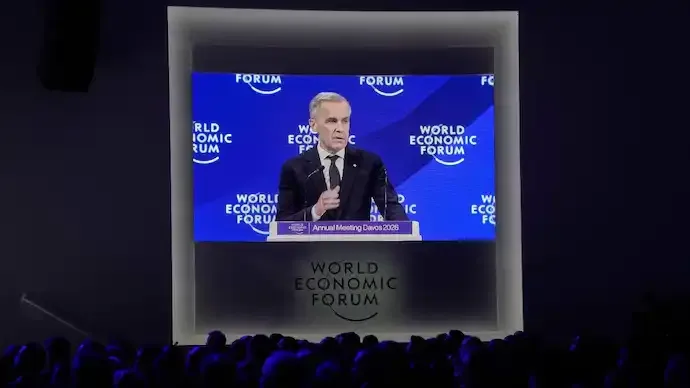
Canada’s Prime Minister Mark Carney delivered one of the most consequential speeches at the World Economic Forum in Davos, declaring that the US-led rules-based international order has not merely weakened but permanently fractured. Speaking before an audience of global leaders and policymakers, Carney offered a blunt assessment of a world increasingly shaped by power politics, economic coercion, and transactional diplomacy.
Carney’s address, delivered a day ahead of a scheduled speech by Donald Trump, marked a clear shift in Canada’s global posture. Rejecting nostalgia for a system that once promised fairness and predictability, Carney warned that middle powers face existential risks if they continue to rely on assumptions that no longer hold true.
According to Carney, the international system has entered an era of “great power rivalry” where economic integration is no longer a shield but a weapon. Tariffs, financial infrastructure, and supply chains, he said, are now routinely used as tools of pressure. In such a world, he cautioned, countries that fail to assert themselves risk being sidelined—or worse.
The Canadian leader urged middle powers to stop performing what he called the “lie of mutual benefit” and instead build dense, resilient networks of alliances. He argued that sovereignty today is not about symbolism or rhetoric, but about real capacity—economic, military, and strategic—to protect national interests.
Carney also warned against over-reliance on bilateral negotiations with hegemonic powers, saying such engagements often force smaller nations into accepting unfavourable terms. True sovereignty, he stressed, requires collective action among middle powers, not passive adaptation to great-power demands.
His speech resonated strongly amid ongoing global tensions, including trade disputes, territorial pressures, and geopolitical flashpoints that have exposed the fragility of existing institutions. Rather than waiting for a return to an old order that no longer exists, Carney called on nations to actively build new frameworks that function as promised.
Below are the most striking quotes from Mark Carney’s Davos address, which captured both the urgency and gravity of his message:
“Every day we are reminded that we live in an era of great power rivalry. That the rules-based order is fading. That the strong do what they can, and the weak suffer what they must.”
“We knew the story of the international rules-based order was partially false. That the strongest would exempt themselves when convenient. That trade rules were enforced asymmetrically.”
“More recently, great powers began using economic integration as weapons. Tariffs as leverage. Financial infrastructure as coercion. Supply chains as vulnerabilities to be exploited.”
“You cannot live within the lie of mutual benefit through integration when integration becomes the source of your subordination.”
“A country that cannot feed itself, fuel itself, or defend itself has few options. When the rules no longer protect you, you must protect yourself.”
“A world of fortresses will be poorer, more fragile, and less sustainable.”
“The old order is not coming back. We should not mourn it. Nostalgia is not a strategy.”
“Great powers can afford to go it alone. Middle powers cannot.”
“This is not sovereignty. It is the performance of sovereignty while accepting subordination.”
“Middle powers must act together, because if you are not at the table, you are on the menu.”
“We are no longer relying on just the strength of our values, but also on the value of our strength.”
Carney’s remarks have since sparked wide debate across diplomatic and strategic circles, positioning his Davos speech as one of the defining interventions of the forum. For many middle powers navigating an increasingly volatile global landscape, his warning was clear: adapt collectively—or risk irrelevance.
171
Published: Jan 21, 2026

All India Story is your trusted source for comprehensive and up-to-the-minute news coverage across India. Bringing you the latest on politics, business, technology, entertainment, sports, and more, we are dedicated to keeping you informed with accurate, engaging, and insightful stories from every corner of the nation.