



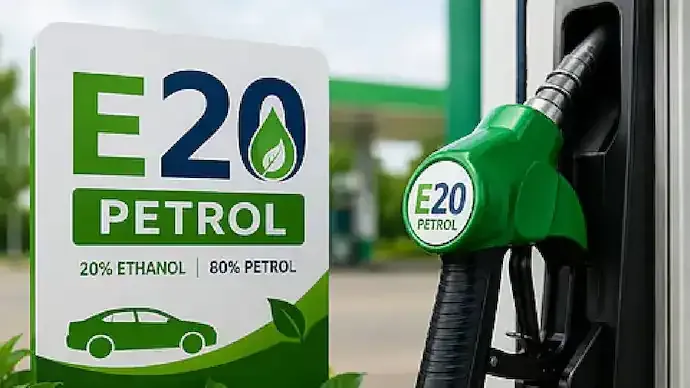
India's ambitious ethanol blending programme has reached a major milestone by achieving the 20% ethanol blending (E20) target five years ahead of schedule. However, the rapid expansion of ethanol production capacity has created a new challenge — the country now has an estimated 700 crore litres of surplus ethanol production capacity beyond its current domestic demand.
While the achievement strengthens India's energy security and reduces crude oil imports, industry experts are now debating how the excess manufacturing capacity will be utilised.
India's Ethanol Capacity Has Expanded Rapidly
Over the past decade, the Centre encouraged massive investments in ethanol production through policy support, long-term procurement contracts and financial assistance.

According to industry estimates, India currently has around 370 operational ethanol distilleries, while another 40 plants are under construction.
The country's installed ethanol production capacity has now reached nearly 2,000 crore litres, whereas current annual demand for fuel blending and industrial use stands at roughly 1,300 crore litres, leaving a notional surplus capacity of around 700 crore litres.
Why Is There a Surplus?
The surplus does not mean India is sitting on unused ethanol inventories.
Instead, it reflects that the country has built production infrastructure capable of manufacturing significantly more ethanol than current domestic consumption requires.
Industry experts say the concern is not excess stock but underutilised production capacity, which could affect plant profitability and the repayment of large investments financed through bank loans.
How India Reached E20 Ahead of Schedule
India's Ethanol Blended Petrol (EBP) Programme began in 2001 with a modest 5% blending target.
After years of policy reforms and increased procurement by oil marketing companies, ethanol blending steadily increased.
The government achieved 10% blending in 2022 before advancing the E20 target from 2030 to the 2025-26 Ethanol Supply Year, eventually achieving it five years early.

Why the Government Promoted Ethanol
The programme was designed to achieve multiple objectives:
- Reduce India's dependence on imported crude oil.
- Improve energy security.
- Lower carbon emissions.
- Increase farmers' income.
- Provide an additional market for sugarcane and grain producers.
Government data states that ethanol blending has resulted in substantial foreign exchange savings while reducing crude oil imports and carbon emissions over the past decade.
Can India Increase Ethanol Blending Beyond E20?
Industry experts believe demand for ethanol will continue to rise as more flex-fuel compatible vehicles enter the market.
The Ministry of Petroleum and Natural Gas has also expressed interest in exploring higher ethanol blends such as E30 in the future.
However, experts caution that widespread adoption would require compatible vehicles, scientific evaluation, and careful consideration of food security, water usage and agricultural land requirements.
Exports May Help Utilise Excess Capacity
The All India Distillers' Association (AIDA) has suggested that exporting ethanol could help absorb surplus production capacity.

Countries such as Nepal, Bangladesh and Indonesia, which are expanding ethanol blending but lack adequate domestic production capacity, are being viewed as potential export markets.
Industry leaders believe exports could provide temporary relief until domestic demand catches up with installed production capacity.
Why Returning to E10 Is Unlikely
Despite concerns over vehicle compatibility and mileage, the government has ruled out reverting to E10 petrol.
According to the Ministry of Petroleum and Natural Gas, public sector banks have financed nearly Rs 1 lakh crore in ethanol plants, storage facilities and logistics infrastructure.
Rolling back to lower ethanol blending levels could undermine those investments and disrupt the country's long-term biofuel strategy.
What Lies Ahead
Experts say India has successfully built a robust ethanol production ecosystem capable of supporting future demand.
The challenge now is ensuring that production capacity remains commercially viable through higher domestic consumption, exports and the gradual expansion of flex-fuel vehicle adoption.
While the current surplus reflects strong infrastructure creation rather than excess unsold fuel, policymakers and industry stakeholders will need to balance energy security, agricultural priorities and commercial sustainability in the years ahead.
Key Highlights
- India has achieved its E20 ethanol blending target five years ahead of schedule.
- Installed ethanol production capacity has reached nearly 2,000 crore litres.
- Current demand leaves a 700 crore litre surplus production capacity.
- Industry is exploring exports to countries including Nepal, Bangladesh and Indonesia.
- The government has ruled out returning to E10 due to large infrastructure investments.
FAQs
Why does India have surplus ethanol capacity?
India expanded production capacity rapidly to meet the E20 blending target, resulting in installed capacity exceeding current domestic demand.
Does surplus capacity mean excess ethanol is lying unused?
No. The concern is about idle production capacity rather than unsold ethanol inventories.
Will India export ethanol?
Industry bodies have suggested exporting surplus ethanol to neighbouring countries that are increasing ethanol blending but have limited production capacity.
Can India move beyond E20?
The government has indicated interest in higher blends such as E30, but wider adoption would require compatible vehicles and further policy planning.
Why won't India return to E10 petrol?
The government says reverting to E10 could jeopardise nearly Rs 1 lakh crore invested in ethanol production and related infrastructure.






Conversation
Be kind and stay on topic. Comments are moderated; abuse, spam and personal attacks are removed. Report a problem