

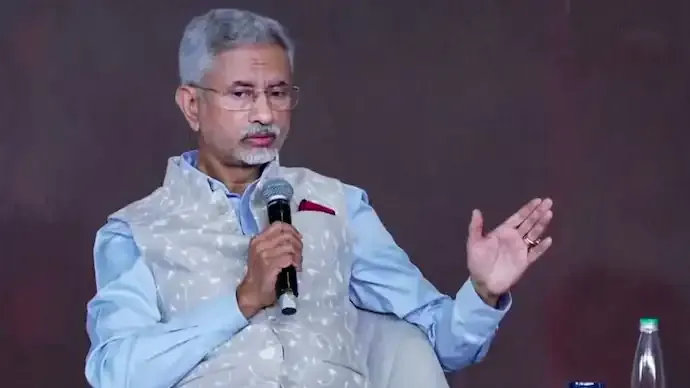
India has every right to defend itself against neighbours that support terrorism, External Affairs Minister S Jaishankar said on Friday, delivering a sharp message that was widely seen as directed at Pakistan. His remarks underline New Delhi’s long-standing position that national security and the protection of citizens remain non-negotiable, especially in the face of cross-border threats.
Speaking on India’s approach to regional security, Jaishankar said that while India seeks peaceful and stable relations with its neighbours, it cannot ignore persistent acts of terrorism emanating from across its borders. He described Pakistan as a “bad neighbour” that has repeatedly backed terrorist activities, adding that India will not hesitate to take necessary steps to safeguard its sovereignty and people.
“India has the right to defend itself,” Jaishankar said, emphasising that no country can be expected to remain passive when faced with sustained security threats. His statement reflects India’s broader diplomatic and strategic doctrine, which combines engagement with firmness when it comes to terrorism and national defence.
India has, for decades, accused Pakistan of providing shelter, training and support to terrorist groups targeting Indian territory, particularly in Jammu and Kashmir. While Pakistan has consistently denied these allegations, New Delhi maintains that evidence shared with the international community demonstrates a pattern of state-backed terrorism. Jaishankar’s comments reinforce India’s argument that terrorism is not a bilateral issue alone, but a global concern that requires accountability.
The External Affairs Minister’s remarks come at a time when regional security dynamics remain tense, with India continuing to push for stronger international action against terrorism. New Delhi has repeatedly called on the global community to adopt a zero-tolerance approach, arguing that selective outrage or political convenience weakens collective efforts to combat extremist violence.
Jaishankar has often stated that India’s foreign policy is guided by realism rather than idealism. In this context, he has argued that good neighbourly relations cannot be built on one-sided restraint. According to him, peace and dialogue can only succeed when there is mutual respect for sovereignty and a clear rejection of terrorism as a policy tool.
India’s stance on self-defence has also evolved in recent years, with the government asserting its right to respond decisively to terror attacks. While officials have avoided detailing operational aspects, the messaging has consistently highlighted that India will act in its national interest and will not allow security threats to go unanswered.
The minister’s statement also aligns with India’s broader diplomatic efforts to highlight terrorism at international forums. From the United Nations to regional groupings, India has sought to frame terrorism as a violation of international norms and human rights, rather than a political instrument. Jaishankar has repeatedly urged countries to abandon double standards and hold accountable those who sponsor or enable extremist violence.
Analysts see the remarks as part of India’s continued effort to clearly define its red lines. By reiterating the right to self-defence, New Delhi is signalling both to its neighbours and the wider world that while it prefers dialogue and cooperation, it will prioritise security when faced with persistent threats.
As geopolitical uncertainties grow and regional rivalries continue to shape South Asia’s security landscape, India’s message remains consistent: peace is desirable, but it cannot come at the cost of safety. Jaishankar’s comments serve as a reminder that India’s approach to terrorism is rooted in the principle that defending one’s people and territory is not an option, but a responsibility.




Conversation
Be kind and stay on topic. Comments are moderated; abuse, spam and personal attacks are removed. Report a problem