Shopping cart
Your cart empty!


Your cart empty!
Terms of use dolor sit amet consectetur, adipisicing elit. Recusandae provident ullam aperiam quo ad non corrupti sit vel quam repellat ipsa quod sed, repellendus adipisci, ducimus ea modi odio assumenda.
Lorem ipsum dolor sit amet consectetur adipisicing elit. Sequi, cum esse possimus officiis amet ea voluptatibus libero! Dolorum assumenda esse, deserunt ipsum ad iusto! Praesentium error nobis tenetur at, quis nostrum facere excepturi architecto totam.
Lorem ipsum dolor sit amet consectetur adipisicing elit. Inventore, soluta alias eaque modi ipsum sint iusto fugiat vero velit rerum.
Sequi, cum esse possimus officiis amet ea voluptatibus libero! Dolorum assumenda esse, deserunt ipsum ad iusto! Praesentium error nobis tenetur at, quis nostrum facere excepturi architecto totam.
Lorem ipsum dolor sit amet consectetur adipisicing elit. Inventore, soluta alias eaque modi ipsum sint iusto fugiat vero velit rerum.
Dolor sit amet consectetur adipisicing elit. Sequi, cum esse possimus officiis amet ea voluptatibus libero! Dolorum assumenda esse, deserunt ipsum ad iusto! Praesentium error nobis tenetur at, quis nostrum facere excepturi architecto totam.
Lorem ipsum dolor sit amet consectetur adipisicing elit. Inventore, soluta alias eaque modi ipsum sint iusto fugiat vero velit rerum.
Sit amet consectetur adipisicing elit. Sequi, cum esse possimus officiis amet ea voluptatibus libero! Dolorum assumenda esse, deserunt ipsum ad iusto! Praesentium error nobis tenetur at, quis nostrum facere excepturi architecto totam.
Lorem ipsum dolor sit amet consectetur adipisicing elit. Inventore, soluta alias eaque modi ipsum sint iusto fugiat vero velit rerum.
Do you agree to our terms? Sign up
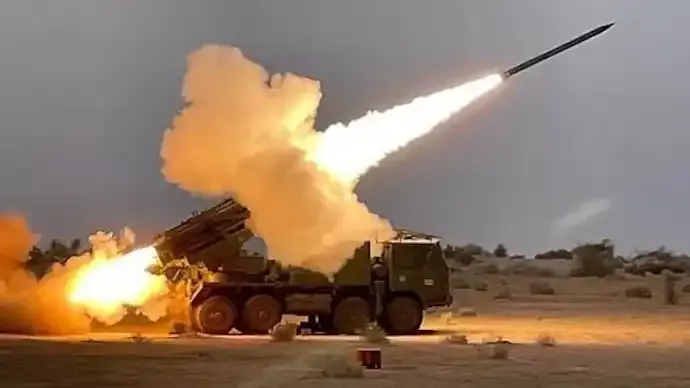
India is moving towards establishing a dedicated rocket-cum-missile force, a long-pending military reform now gaining urgency amid escalating security challenges from Pakistan and China. The push comes in the wake of Operation Sindoor, the Ukraine war, and ongoing conflicts in the Middle East, all of which have underlined the growing dominance of long-range precision strikes and non-contact warfare.
Speaking on Army Day, General Upendra Dwivedi said India must move towards a unified command for rockets and missiles, noting that both Pakistan and China already operate specialised rocket forces. He described such a unit as the “need of the hour,” stressing that modern battlefields increasingly blur the distinction between rockets and guided missiles.
Currently, India’s missile and rocket capabilities are spread across the artillery regiments and the Corps of Army Air Defence. However, post-Operation Sindoor, where India successfully struck terror infrastructure deep inside Pakistan, military planners have been reassessing the effectiveness of fragmented command structures for long-range strike assets.
India possesses a diverse arsenal that includes Agni, Prithvi, BrahMos, Pralay and the Pinaka guided rocket system, which recently achieved a range of 120 km. According to the Army chief, contracts for missiles with ranges between 300 and 450 km have already been finalised, signalling a shift toward deeper and faster strike capabilities.
The urgency is driven by developments across India’s borders. China’s People’s Liberation Army Rocket Force controls both conventional and nuclear missiles and operates with minimal civilian oversight. US estimates suggest China has over 1,250 ballistic and cruise missiles and a rapidly expanding nuclear stockpile. Pakistan, meanwhile, has set up its Army Rocket Force Command, reportedly modelled on China’s system, following setbacks during Operation Sindoor.
While India remains ahead of Pakistan in missile quality and technological sophistication, experts warn that Pakistan’s new rocket force could pose challenges during short, high-intensity conflicts through saturation attacks.
It is in this context that Iran’s missile doctrine offers valuable insights. Iran has built one of the world’s largest and most resilient missile forces under the Islamic Revolutionary Guard Corps Aerospace Force, which operates independently of the regular air force and reports directly to the country’s top leadership.
Established in 2009, Iran’s aerospace force controls ballistic, cruise and hypersonic missiles, as well as drone operations. Its capabilities were demonstrated during last year’s conflict with Israel, when Iranian missile barrages penetrated air defence systems and struck strategic targets.
One of Iran’s biggest strengths lies in its extensive underground tunnel networks, which conceal missile stockpiles and launch platforms, making pre-emptive strikes difficult. US assessments estimate Iran possesses nearly 3,000 ballistic missiles, the largest such arsenal in the Middle East, giving it significant deterrence leverage against stronger adversaries.
For India, the key lessons lie in unified command, survivability of missile assets, underground infrastructure, and rapid-response strike capability. As warfare increasingly shifts toward precision strikes and drones, India’s move to raise a rocket-missile force reflects a strategic recalibration shaped by real battlefield experience.
With Pakistan and China both expanding their missile commands, India’s evolving doctrine signals a clear intent to adapt to modern warfare realities.
89
Published: Jan 14, 2026

All India Story is your trusted source for comprehensive and up-to-the-minute news coverage across India. Bringing you the latest on politics, business, technology, entertainment, sports, and more, we are dedicated to keeping you informed with accurate, engaging, and insightful stories from every corner of the nation.