

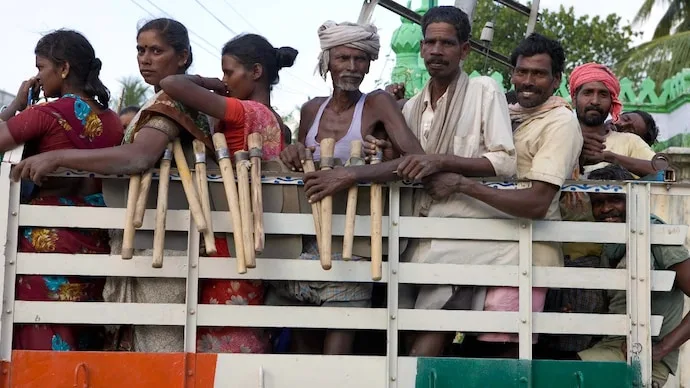

In August 2025, inter-State migrant workers from Odisha and Chhattisgarh were rescued from two shrimp farms in Andhra Pradesh’s Prakasam district after allegedly facing conditions resembling bonded labour. The 40 workers, including women and a minor, were reportedly housed in cramped rooms, denied timely wages and provided inadequate food. Restrictions on their movement and alleged physical abuse further highlighted the vulnerabilities of migrant labourers.
An Escape Exposed the Alleged Exploitation
The case came to light after a worker from Bastar district escaped, returned to Chhattisgarh and complained to the District Collector. The complaint prompted coordination between the administrations of Chhattisgarh and Andhra Pradesh, leading to a rescue operation involving police, revenue and labour officials, along with voluntary organisations.
The workers were moved to a relief centre in Ongole. Relief certificates were issued, and directions were given to pay outstanding wages and arrange their return home.

The incident raises questions about why the alleged exploitation remained undetected until a worker escaped and approached the authorities.
The 1979 Law and Its Promise
The Inter-State Migrant Workmen (Regulation of Employment and Conditions of Service) Act, 1979, was introduced to address exploitation associated with contractor-recruited labour, including the Dadan labour system prevalent in Odisha and other states.
The legislation required the registration of establishments and licensing of contractors employing five or more inter-State migrant workers. It also provided for employment passbooks, wages and working conditions comparable to those of local workers, displacement allowances, journey allowances, suitable accommodation, medical facilities and protective clothing.
However, the existence of statutory provisions did not guarantee that workers actually received these benefits.
A parliamentary Standing Committee on Labour report presented in December 2011 highlighted inadequate implementation, a lack of comprehensive worker data and weaknesses in the registration of establishments, contractors and migrant workers. It called for substantive legislative changes rather than a narrow revision of terminology.
COVID-19 Exposed the Scale of Migration
The vulnerability of migrant workers became particularly visible during the COVID-19 pandemic. According to information collected by the Union Ministry of Labour and Employment, approximately 1.14 crore inter-State migrant workers returned to their home states during the first wave in 2020.
In its June 29, 2021, judgment in In Re: Problems and Miseries of Migrant Labourers, the Supreme Court directed the development and implementation of a national database for unorganised and migrant workers.
The government subsequently launched the e-Shram portal on August 26, 2021, to register unorganised workers, including migrants. The e-Shram One-Stop Solution followed on October 21, 2024, to improve access to social-security and welfare schemes through a single platform.
By August 18, 2026, e-Shram had recorded 31.89 crore registrations. However, this figure covers multiple categories of unorganised workers and should not be interpreted as the number of inter-State migrants.
The New Labour Code: Wider Coverage, Different Safeguards
The Occupational Safety, Health and Working Conditions Code, 2020, came into force on November 21, 2025, subsuming the 1979 Act and twelve other labour enactments.
The new framework expands the definition of inter-State migrant workers to include people who migrate independently and secure employment in another state, as well as those recruited directly or through contractors.
Section 60 addresses access to benefits available to other workers, including applicable social-security benefits and medical check-ups. Section 62 provides for schemes supporting access to the public distribution system in either the home or destination state and portability of specified construction-worker benefits. Section 63 enables governments to provide toll-free helplines.
Section 21(2) requires the Central and State Governments to maintain records or databases of inter-State migrant workers and permits self-registration through the prescribed portal.
Yet, the Code also introduces limitations. The definition includes a monthly wage ceiling of ₹18,000, or a higher amount notified by the Central Government. Under Section 59, the special provisions in Part II of Chapter XI apply to establishments employing ten or more such workers, compared with the earlier threshold of five.
The new Code does not contain a corresponding provision for the displacement allowance specifically guaranteed under the 1979 Act. Under Rule 102 of the 2026 Central Rules, journey allowance is payable once in twelve months after at least 180 days of service in the preceding twelve months, subject to prescribed conditions. This requirement could disadvantage seasonal and short-term workers.
The earlier provisions concerning wages during journeys, passbooks and certain migrant-specific obligations for accommodation, free medical facilities and protective clothing have also not been retained in the same form.
Registration Must Translate Into Real Benefits
Migration driven by drought, crop failures and declining agricultural employment presents additional challenges. Workers moving within their own states can face similar hardships, yet they do not qualify for the special inter-State migrant-worker protections solely because they have migrated.
Aggregate registration figures alone cannot establish whether eligible workers have been identified, whether employers comply with the law or whether statutory benefits reach their intended recipients.
Regular publication of state-wise data on registrations, inspections, violations, prosecutions and benefit delivery would help assess implementation. Coordination between source and destination states is equally important, as is an administrative system capable of responding promptly to workers’ grievances.
Trade unions also have a role in ensuring that workers’ welfare remains central to their activities.
Ultimately, the effectiveness of migrant labour legislation depends not simply on the number of protections written into law, but on whether workers can access them in practice.









Conversation
Be kind and stay on topic. Comments are moderated; abuse, spam and personal attacks are removed. Report a problem