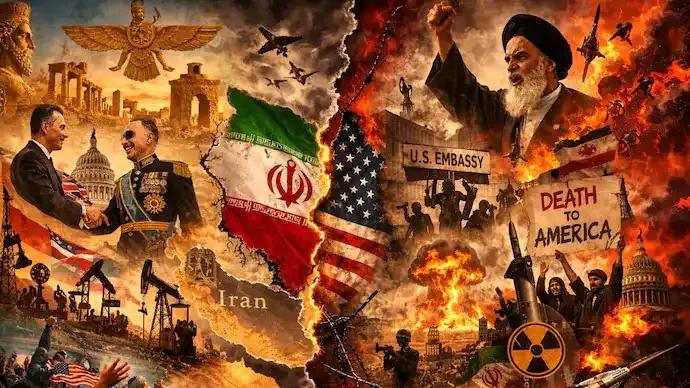
The rivalry between Iran and the United States is one of the most complex geopolitical conflicts in modern history. What began as a strategic partnership during the mid-20th century gradually transformed into deep hostility marked by political distrust, ideological conflict, and military tensions.
Over decades, this relationship shifted dramatically—from cooperation to confrontation—shaping regional politics across the Middle East and influencing global diplomacy.
Early Alliance Between Iran and the United States
In the early twentieth century, Iran and the United States maintained relatively positive relations. The relationship strengthened significantly during the reign of Shah Mohammad Reza Pahlavi, when Iran was seen as a key ally of the United States in the Middle East.
The United States supported Iran politically, economically, and militarily, viewing the country as an important partner in countering Soviet influence during the Cold War. Washington also invested heavily in Iran’s modernization efforts and helped expand its oil industry.
During this period, Iran became one of the most strategically important American allies in the region.
The 1953 Coup and Growing Resentment
One of the most significant turning points in Iran–US relations occurred in 1953. Iran’s Prime Minister Mohammad Mossadegh had attempted to nationalise the country’s oil industry, which had previously been controlled largely by foreign companies.
The move created tensions with Western powers. Soon after, Mossadegh was removed from power in a coup that restored the Shah’s authority.
Many Iranians later viewed this event as foreign interference in their political sovereignty. Over time, the coup became a powerful symbol of resentment toward Western involvement in Iran’s internal affairs.
The Iranian Revolution of 1979
The relationship between the two countries deteriorated dramatically during the Iranian Revolution in 1979. Mass protests against the Shah’s rule eventually forced him to leave the country.
Ayatollah Ruhollah Khomeini returned from exile and established an Islamic Republic. The new government strongly criticised the United States, accusing it of supporting an oppressive regime in Iran.
Soon after the revolution, Iranian students seized the US embassy in Tehran and held American diplomats hostage for 444 days. The incident deeply damaged relations and led to the severing of diplomatic ties between the two countries.
Decades of Conflict and Sanctions
Following the revolution, relations between Iran and the United States remained tense. The two countries frequently clashed over regional conflicts, nuclear ambitions, and geopolitical influence.
The United States imposed a series of economic sanctions on Iran, while Iranian leaders continued to describe the US as the “Great Satan,” reflecting deep ideological opposition.
Over the years, disputes have emerged over Iran’s nuclear programme, military activities, and its role in regional conflicts across the Middle East.
Continuing Tensions in the Modern Era
In recent years, tensions between Iran and the United States have intensified due to regional conflicts and strategic rivalry. Military incidents, diplomatic disputes, and economic pressure have kept the relationship fragile.
Both countries remain deeply influential in shaping Middle Eastern geopolitics, and their rivalry continues to affect global security discussions.
Experts often note that the Iran–US conflict is rooted not only in political disagreements but also in decades of historical grievances and mistrust.
A Conflict With Global Implications
The relationship between Iran and the United States continues to influence international diplomacy, energy markets, and regional stability.
Because the Middle East remains strategically important for global oil supplies and geopolitical alliances, tensions between these two nations often attract worldwide attention.
The long history of hostility between Iran and the United States shows how alliances can evolve into rivalries over time, shaped by political decisions, revolutions, and competing national interests.
Prev Article
Pakistan Airstrike Hits Kabul Hospital: 400 Dead, 250 Injured in Afghanistan
Next Article
Mojtaba Khamenei Survived Missile Strike Seconds Before Attack That Killed Ali Khamenei