Israel has recovered the remains of the last hostage held in Gaza, bringing closure to a deeply emotional chapter of the war and paving the way for the next, more complex phase of the ceasefire with Hamas. The development is expected to unlock key provisions of the truce, including the reopening of Gaza’s border with Egypt and an expansion of humanitarian access to the war-ravaged enclave.
The remains were identified as those of Ran Gvili, a young Israeli police officer who was killed during the Hamas-led attack of October 7, 2023 — the assault that triggered the ongoing conflict. His body was located in a cemetery in northern Gaza following coordinated recovery efforts.
The return of Gvili’s remains fulfils the final requirement of the ceasefire’s first phase, under which all hostages — living or deceased — were to be returned. Israeli authorities confirmed that this milestone clears the way for discussions on the second phase, which involves far more contentious political and security issues.
Israeli Prime Minister Benjamin Netanyahu described the recovery as a significant achievement for Israel’s military and intelligence services, stating that the operation demonstrated the country’s commitment to bringing every hostage home.
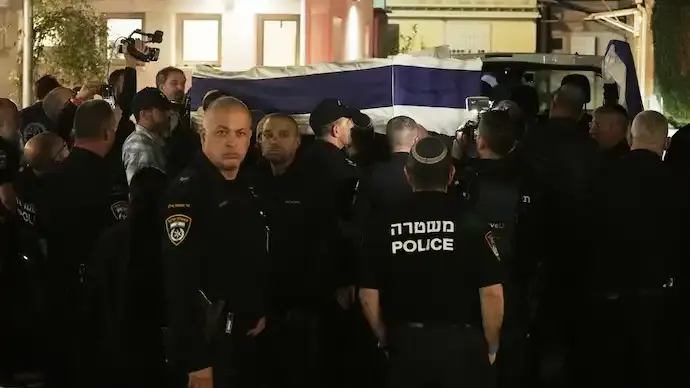
A solemn convoy carrying Gvili’s coffin crossed into Israel, where dozens of mourners, security personnel and civilians lined the roads to pay their respects. The coffin, draped in the national flag, was transported to Tel Aviv as crowds stood silently in tribute, reflecting the collective weight the hostage crisis has carried within Israeli society.
With the recovery completed, Israeli officials indicated that the Rafah crossing — Gaza’s main gateway to the outside world — is likely to reopen in coordination with Egypt. The crossing has largely remained closed since mid-2024, severely restricting movement of people and goods. Its reopening is expected to allow Palestinians to travel, enable medical evacuations and significantly increase the flow of aid into Gaza.
For many Palestinians, the prospect of Rafah reopening offers cautious hope. Families displaced by two years of war say access to medical care, shelter materials and food supplies remains critically limited. Humanitarian agencies have confirmed that large volumes of aid are currently positioned in Egypt, ready to move once border access is restored.
The second phase of the ceasefire, however, presents formidable challenges. It includes proposals for disarming Hamas, withdrawing Israeli forces from parts of Gaza, deploying an international security mechanism and initiating long-term reconstruction. Israeli leadership has emphasised that demilitarisation must precede any large-scale rebuilding effort, while Hamas has historically rejected disarmament demands.
International mediators are expected to play a decisive role in navigating the transition. Regional and global stakeholders view the current moment as fragile, warning that failure to implement phase two could unravel the ceasefire entirely.
Despite the truce, violence has not fully ceased. Palestinian officials report continued casualties in Gaza since the ceasefire began, underscoring persistent tensions on the ground. Meanwhile, debates within Israel over the war’s direction, accountability and humanitarian access continue to intensify.
Symbolically, Israel’s president removed the yellow pin worn nationwide to represent solidarity with hostages and their families, marking what many see as the end of one chapter — and the uncertain beginning of another.
As the focus shifts from hostage recovery to governance, security and rebuilding, the success of the next phase will determine whether the ceasefire evolves into a sustainable path forward or collapses under unresolved disputes.
Prev Article
Bangladesh Tribunal Sentences Former Dhaka Police Chief, Two Officers to Death Over 2024 Protest Crackdown
Next Article
Abolish ICE Call Grows as Zohran Mamdani Accuses White House of Terrorising Minneapolis