
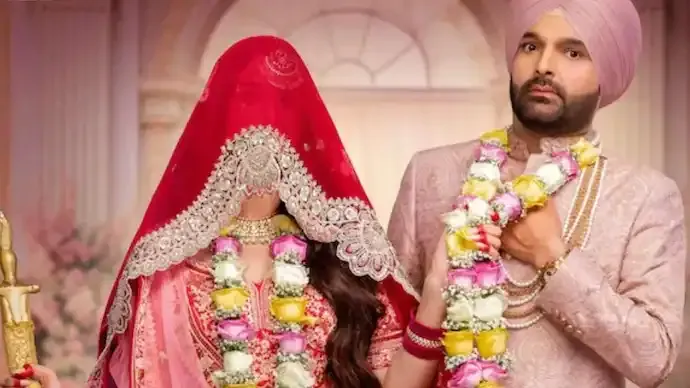
Kis Kisko Pyaar Karoon 2 brings Kapil Sharma back to the big screen with a sequel that leans fully into the chaos-driven comedy that made the first film a crowd favourite. This time, the plot escalates to what feels like a multiverse of brides—three wives from three different religions, a fourth love interest reappearing at her convenience, and a protagonist trapped in a maze of lies, misunderstandings and comedic disasters.
The film opens with a line that perfectly captures its essence: “Insaan ho ya samvidhaan, jo sabko apnaoge…” It’s a punchline that triggers loud laughter but also serves as a thesis for the film’s playful take on unity, acceptance and the absurdity of Mohan’s tangled personal life.
Kapil Sharma appears far more at ease in the sequel, fully embracing a performance style reminiscent of his television persona—quick wit, expressive reactions and impeccable timing. The writers clearly build the screenplay around Kapil’s strengths, allowing him to shine in scenes that rely on comic panic, helplessness and exaggerated situations. His physical transformation also adds a renewed sharpness and confidence to his on-screen presence.
The triangular—or rather quadrangular—marriage plot uses cultural contrasts for humour: Islamic wedding rituals, stereotypical Goan lingo, and exaggerated behavioural patterns. While some jokes land smoothly, others feel stretched or recycled from Kapil’s stage comedy days. Yet the film never positions itself as cerebral comedy—its goal is lighthearted escapism, and it remains faithful to that purpose.
The female characters are written as broad archetypes, each distinct enough for audiences to keep track but not layered enough to leave lasting impact. Hira Warina, presumably the film’s lead, gets surprisingly little to work with. Tridha Choudhury delivers glamour in a well-shot dance number, and Ayesha Khan shifts gears into a gentler role after her bold appearance in Dhurandhar. Parul Gulati’s character, however, barely registers.
Where the film stumbles is in the second half. The screenplay begins to lose momentum as it abruptly tries to introduce emotional beats and socio-cultural messaging. Themes of unity, secularism and acceptance are admirable but feel tacked on rather than organically developed. The narrative is strongest when it leans unapologetically into slapstick chaos.
The climax, however, compensates with a loud, energetic sequence packed with chases, coincidences and comic mayhem. Cameo-style humour—such as Navjot Singh Sidhu references and nods to Savdhaan India—adds nostalgia and levity. The music, barring a Yo Yo Honey Singh track, is forgettable.
Ultimately, debut director Anukalp Goswami delivers a film designed for viewers who want familiar Kapil Sharma-style entertainment. It is not smart comedy, nor does it claim to be—it’s a loud, colourful, comfort watch that invites the audience to switch off and indulge in harmless madness.
Rating: 2.5/5


Conversation
Be kind and stay on topic. Comments are moderated; abuse, spam and personal attacks are removed. Report a problem