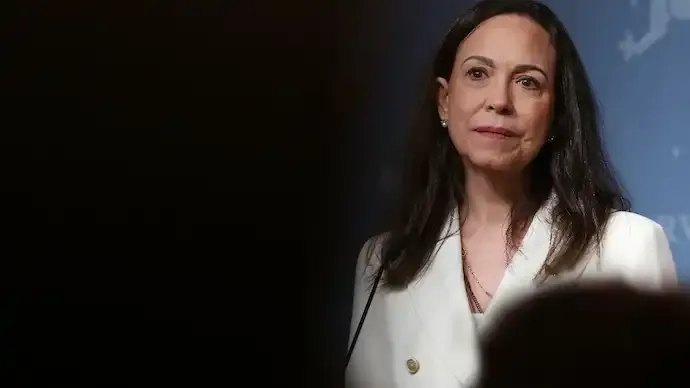
Venezuelan opposition leader and Nobel Peace Prize laureate Maria Corina Machado has expressed strong confidence that Venezuela is heading towards an orderly democratic transition, even as she acknowledged the deep political and institutional challenges facing the country after decades of authoritarian rule.
Speaking in Washington at an event hosted by the Heritage Foundation, Machado said Venezuela had reached a decisive turning point following the ouster of former president Nicolás Maduro. While she refrained from outlining a specific timeline, she maintained that the process of democratic restoration was now irreversible.
“I am profoundly, profoundly confident that we will have an orderly transition,” Machado said, adding that a democratic Venezuela would fundamentally reset its global posture and emerge as a close ally of the United States after years of hostility with Washington.
No Timeline, But Firm Optimism
Machado declined to provide details on when elections might be held or when she would return to Venezuela, saying only that she would go back “as soon as possible.” Her remarks reflected the fragile political environment in Caracas, where power structures built over nearly three decades remain deeply entrenched.
Despite her optimism, she acknowledged the scale of the challenge involved in dismantling a system that has relied on loyal security forces and international backing from countries such as Russia and Iran.
US-Backed Interim Arrangement Complicates Picture
Machado’s comments come amid a complex political backdrop. While she remains the most recognisable face of Venezuela’s democratic movement, US President Donald Trump has backed an interim leadership arrangement that currently places Maduro ally Delcy Rodríguez at the helm.
The move has effectively sidelined Machado’s camp for now, even as Washington pushes for a managed and controlled transition. During the same week Machado met Trump at the White House, CIA Director John Ratcliffe reportedly held talks with Rodríguez in Caracas, signalling US preference for stability over a sudden power shift.
Machado dismissed suggestions that US engagement with Rodríguez undermined her position. She said the issue was not about rivalry but about fear within the remnants of the old regime.
Security Forces and Social Cohesion
Addressing concerns over whether a post-Maduro leadership could command loyalty from the security forces, Machado argued that Venezuelan society lacks deep internal divisions that might derail a transition.
She said there were no major religious, racial, or regional fault lines, but conceded that dismantling a 27-year-old power structure would not be easy, especially one reinforced by foreign alliances.
Deference to Washington’s Role
Machado struck a cautious and deferential tone when discussing the Trump administration’s role, avoiding public prescriptions on what Washington should do next. She suggested that US support was already central to Venezuela’s future and did not require public pressure from her side.
Trump, for his part, has largely focused on reviving Venezuela’s oil sector and maintaining an oil blockade to keep the interim leadership in check. US officials are also reportedly considering reopening the US embassy in Caracas, a sign of cautious re-engagement.
Nobel Medal Gesture and Political Reality
During her White House visit, Machado presented Trump with her Nobel Peace Prize medal, praising his role in Venezuela’s struggle for freedom. While Trump accepted the medal and spoke warmly of her, the Nobel Institute later clarified that the prize itself is non-transferable.
The symbolic gesture did not shield Machado from political realism. Trump later remarked that it would be difficult for her to lead Venezuela, claiming she lacked sufficient domestic support and respect inside the country.
A Delicate Road Ahead
Despite mixed signals from Washington and uncertainty on the ground, Machado remains publicly confident that Venezuela will move toward democracy through an orderly process. Her remarks underscore both hope and caution, reflecting a transition shaped as much by international diplomacy as by internal political will.
As Venezuela navigates this uncertain phase, Machado’s confidence contrasts sharply with the complexities of power-sharing, security control, and foreign influence that continue to define the country’s fragile future.
Prev Article
How a Secret Sea Rescue Helped Maria Corina Machado Reach Her Nobel Ceremony
Next Article
Trump Intensifies Greenland Push, Warns Denmark Over ‘Russian Threat’ and Imminent Action