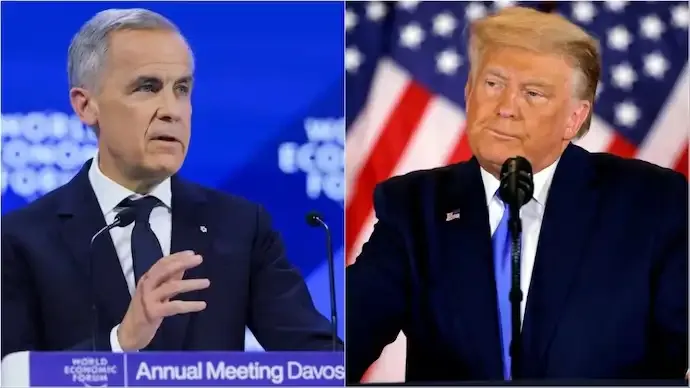
Canadian Prime Minister Mark Carney has firmly stood by the remarks he delivered at the World Economic Forum in Davos, making it clear that he did not soften or retract any part of his speech during a recent phone conversation with US President Donald Trump. The clarification comes amid growing tensions between Ottawa and Washington over trade, tariffs and the future of the global economic order.
Addressing lawmakers in Canada’s Parliament, Carney rejected claims that he had walked back his Davos comments following criticism from Washington. He was responding directly to allegations by US Treasury Secretary Scott Bessent, who suggested that the Canadian leader had taken a more conciliatory tone in his private exchange with Trump.
“To be absolutely clear, I meant what I said in Davos,” Carney stated, emphasising that his message to the US president was consistent with his public position. He added that his conversation with Trump was frank and unambiguous, reflecting what he described as a changed global and American political reality.
In his Davos address, Carney argued that long-standing global trade norms—many of which were shaped and championed by the United States over decades—are eroding under the weight of recent policy shifts. He pointed to aggressive tariff measures and unilateral trade actions as evidence that the traditional rules-based international order is no longer functioning as it once did.
“The world has changed, and Washington has changed,” Carney said while speaking in Parliament. “There is almost nothing normal now in the United States, and that reality has consequences for global trade and diplomacy.” He added that the previous global economic framework is unlikely to return in its original form.
The Canadian leader has since accelerated efforts to diversify Canada’s trade relationships, reducing reliance on the US market, which currently absorbs roughly 70 percent of Canadian exports under the United States-Mexico-Canada Agreement. Carney has argued that broader trade partnerships are necessary to protect Canada’s economic resilience in an increasingly unpredictable global environment.
Trump responded sharply to Carney’s Davos remarks, at one point suggesting that Canada’s economic position exists largely due to its relationship with the United States. He also warned that Washington could impose a 100 percent tariff on Canadian imports if Ottawa were to pursue a trade agreement with China. Carney dismissed the possibility, stating that Canada has no plans to enter into a free trade deal with Beijing.
Further straining relations, the United States withdrew an invitation for Canada to participate in a new international peace initiative proposed by the Trump administration. Despite these developments, Carney maintained that dialogue between the two countries remains open.
He said his discussion with Trump focused on Canada’s strategy of responding to tariffs by strengthening domestic industries while expanding partnerships abroad, even as Ottawa remains willing to engage constructively within the existing North American trade framework. According to Carney, Trump acknowledged this position during their call.
Carney also informed lawmakers that preparations are underway for a formal review of the USMCA, scheduled to take place later this year. While details remain limited, he said preliminary work on the review would begin in the coming weeks.
The exchange underscores a widening philosophical divide between the two leaders over trade, globalisation and international cooperation, even as both sides signal an intent to keep communication channels open amid rising economic uncertainty.
Prev Article
Trump Health Scrutiny Grows After Alzheimer’s Remark in Interview
Next Article
Buzz Over Khamenei’s Safety and Successor as US Navy Builds Pressure on Iran