Shopping cart
Your cart empty!


Your cart empty!
Terms of use dolor sit amet consectetur, adipisicing elit. Recusandae provident ullam aperiam quo ad non corrupti sit vel quam repellat ipsa quod sed, repellendus adipisci, ducimus ea modi odio assumenda.
Lorem ipsum dolor sit amet consectetur adipisicing elit. Sequi, cum esse possimus officiis amet ea voluptatibus libero! Dolorum assumenda esse, deserunt ipsum ad iusto! Praesentium error nobis tenetur at, quis nostrum facere excepturi architecto totam.
Lorem ipsum dolor sit amet consectetur adipisicing elit. Inventore, soluta alias eaque modi ipsum sint iusto fugiat vero velit rerum.
Sequi, cum esse possimus officiis amet ea voluptatibus libero! Dolorum assumenda esse, deserunt ipsum ad iusto! Praesentium error nobis tenetur at, quis nostrum facere excepturi architecto totam.
Lorem ipsum dolor sit amet consectetur adipisicing elit. Inventore, soluta alias eaque modi ipsum sint iusto fugiat vero velit rerum.
Dolor sit amet consectetur adipisicing elit. Sequi, cum esse possimus officiis amet ea voluptatibus libero! Dolorum assumenda esse, deserunt ipsum ad iusto! Praesentium error nobis tenetur at, quis nostrum facere excepturi architecto totam.
Lorem ipsum dolor sit amet consectetur adipisicing elit. Inventore, soluta alias eaque modi ipsum sint iusto fugiat vero velit rerum.
Sit amet consectetur adipisicing elit. Sequi, cum esse possimus officiis amet ea voluptatibus libero! Dolorum assumenda esse, deserunt ipsum ad iusto! Praesentium error nobis tenetur at, quis nostrum facere excepturi architecto totam.
Lorem ipsum dolor sit amet consectetur adipisicing elit. Inventore, soluta alias eaque modi ipsum sint iusto fugiat vero velit rerum.
Do you agree to our terms? Sign up
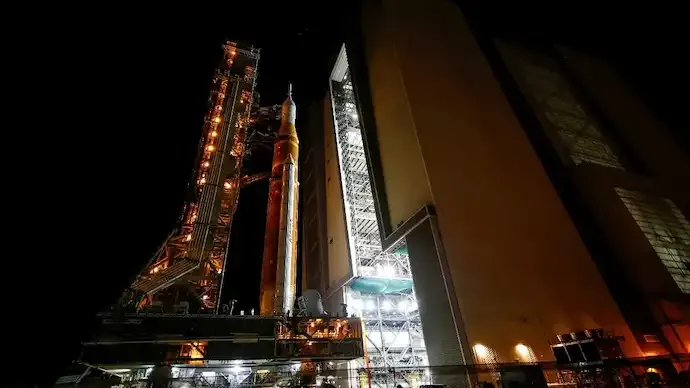
The NASA is preparing to launch its next major Moon mission, Artemis II, on April 1, marking a historic step in humanity’s return to deep space exploration.
The mission will carry four astronauts on a journey around the Moon before returning safely to Earth. It will be the first crewed lunar mission since the final Apollo mission in 1972, signalling the beginning of a new era of space exploration.
Engineers are currently completing final preparations at the Kennedy Space Center in Florida, where the rocket and spacecraft are being assembled for launch.
The Artemis II mission will be the first crewed flight of NASA’s powerful Space Launch System (SLS) rocket. The astronauts will travel aboard the Orion spacecraft, which is designed to carry humans safely beyond Earth’s orbit.
The SLS rocket is currently the most powerful rocket developed by NASA and plays a central role in the Artemis programme. Once launched, it will propel the Orion capsule carrying the crew toward the Moon.
The mission will not involve a lunar landing. Instead, the spacecraft will fly around the Moon and return to Earth, testing systems required for future missions.
Teams at the Kennedy Space Center are completing final integration and testing inside the Vehicle Assembly Building, one of the world’s largest structures used for assembling rockets.
Engineers are conducting system checks on the rocket, spacecraft and life-support systems to ensure everything functions properly during the mission.
These final preparations are critical because Artemis II will be the first time astronauts fly on the new SLS-Orion combination.
Artemis II is part of NASA’s broader Artemis programme, which aims to establish a sustainable human presence on the Moon.
The programme includes several missions planned over the coming years, eventually leading to astronauts landing on the lunar surface again.
Future missions are also expected to help scientists prepare for long-duration space travel, including potential missions to Mars.
The last time humans travelled to the Moon was during the Apollo era, when astronauts walked on the lunar surface between 1969 and 1972.
With Artemis II, NASA aims to test systems required to safely send humans deeper into space once again.
The mission will evaluate spacecraft navigation, life-support systems, communications and astronaut operations during a long journey around the Moon.
The Artemis programme has attracted global attention as countries and private companies expand their space exploration ambitions.
Many international space agencies are collaborating with NASA to support lunar exploration technologies and scientific missions.
If successful, Artemis II will pave the way for future missions that could return astronauts to the lunar surface and establish a new phase of human exploration beyond Earth.
5
Published: 1h ago

All India Story is your trusted source for comprehensive and up-to-the-minute news coverage across India. Bringing you the latest on politics, business, technology, entertainment, sports, and more, we are dedicated to keeping you informed with accurate, engaging, and insightful stories from every corner of the nation.