

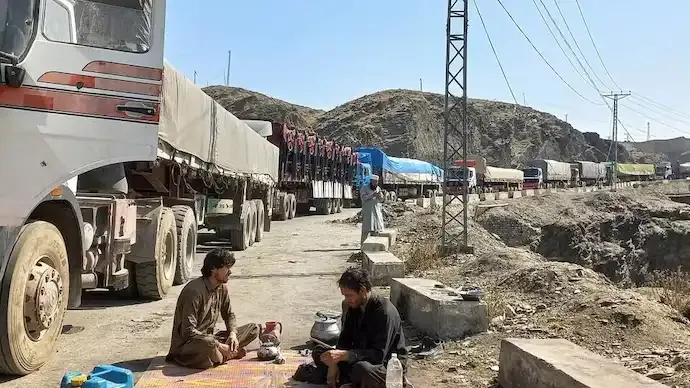

Pakistan’s escalating trade conflict with Afghanistan — triggered by Islamabad’s decision to shut border crossings and halt bilateral commerce — is inflicting heavy economic damage on Pakistan itself, even as the Taliban regime quickly pivots to alternative markets and routes.
The confrontation began after Pakistan’s DG ISPR, Lt Gen Ahmed Sharif Chaudhry, declared that “blood and business cannot go together,” following border tensions and the mass expulsion of Afghan nationals. But the move has sharply rebounded against Pakistan, worsening shortages, disrupting industries, and causing major financial losses across key sectors.
Afghanistan diversifies; Pakistan’s economy absorbs the shock
After Pakistan closed major trade points on October 11, Afghanistan rapidly rerouted commercial flows through Iran, Central Asia, Turkey, and even India. This strategic shift, reported by outlets such as Dawn and Ariana News Network, has softened the impact for Kabul but intensified the crisis for Pakistan.

Pakistan’s manufacturing hubs — especially in Khyber Pakhtunkhwa — have been hit severely. Businesses have warned that the 45-day trade freeze has caused losses worth trillions of rupees. Delegations of distressed traders have approached political leaders, appealing for the immediate reopening of the Durand Line crossings.
Meanwhile, Afghanistan, one of the poorest countries globally with a per capita GDP of $434, is using the crisis to deepen economic ties with new partners. The Taliban’s Industry and Commerce Minister, Alhaj Nooruddin Azizi, recently led delegations to India, underscoring Kabul’s determination to diversify its trade network beyond Pakistan.
Cement, coal, medicines, agriculture: Pakistan’s sectors under stress
Pakistan’s cement sector is among the hardest hit. Afghan coal — once a cheaper, reliable raw material — has disappeared from Pakistan’s supply chain. Manufacturers are now forced to import significantly costlier coal from South Africa, Mozambique, and Indonesia, pushing local coal prices from PKR 30,000–32,000 per tonne to as high as PKR 45,000.
Pharmaceutical exports have collapsed as well. Pakistan earlier exported $187 million worth of medicines annually to Afghanistan. With borders closed, consignments remain stuck in factories, and some drugs cannot be sold domestically due to regulatory restrictions.
Agricultural produce has also suffered. Tons of perishable fruits and vegetables have rotted due to halted exports, while shortages have caused prices of imported fruits to double in Pakistani markets. Transport workers, small traders, and labourers are now confronting unemployment and debt.
Revenue losses and falling foreign exchange inflows
The trade freeze has slashed customs revenue and transit duties at a time when Pakistan desperately needs foreign reserves. Analysts warn that continued disruptions could complicate Islamabad’s fragile economic recovery and deepen local inflation.
Afghan–Pakistan ties at their lowest point
Diplomatic relations between Islamabad and Kabul have plunged since the Taliban takeover in 2021. Cross-border violence, counter-terror allegations, airstrikes, and failed negotiations have created deep mistrust. According to ORF, terrorist attacks inside Pakistan have surged, further hardening Islamabad’s stance.
In response, the Taliban have grown increasingly assertive. In early November, Afghanistan’s Deputy PM Mullah Ghani Baradar urged Afghan traders to stop using Pakistan’s transit routes entirely, warning that Kabul would not support businesses that continue relying on Pakistan.
Internal backlash weakens Islamabad’s position
At Bacha Khan Markaz in Khyber Pakhtunkhwa, traders, transporters, and political leaders held a jirga demanding immediate reopening of border trade. They criticised the Shehbaz Sharif government for blocking Afghan trade while previously allowing commerce with India despite tensions.
Pashtun groups have warned that the trade blockade disproportionately harms their community’s livelihoods and regional stability.
A strategy backfiring on Pakistan
Pakistan’s Defence Minister Khawaja Asif described the trade closures as a “blessing in disguise,” claiming they would help prevent terrorism. But the real economic burden is falling on ordinary Pakistani workers, exporters, and industries.
Meanwhile, Afghanistan, despite its struggling economy, is building new trade partnerships and reducing dependence on Pakistan — signalling a long-term strategic shift that could permanently reshape regional commerce.






Conversation
Be kind and stay on topic. Comments are moderated; abuse, spam and personal attacks are removed. Report a problem