

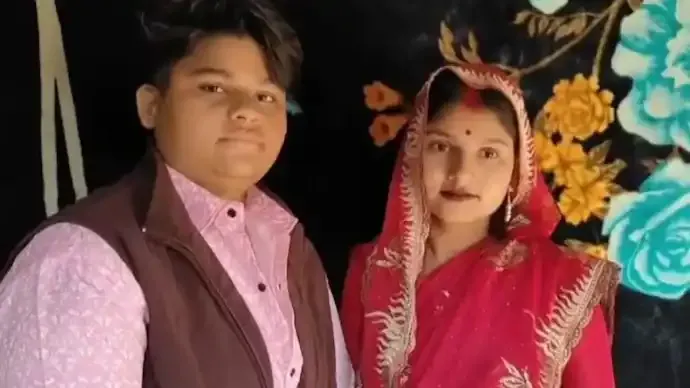

In a region where tradition often shapes social choices, a quiet yet powerful story of acceptance unfolded in Charkhari town of Uttar Pradesh’s Mahoba district. Two young women, Hema and Pooja, who had been in a relationship for nearly three years, returned to their hometown after marrying in Delhi — and were welcomed not with resistance, but with songs, rituals and open-hearted celebration.
Their story has since travelled far beyond the lanes of Bundelkhand, sparking conversations on love, family consent and changing social attitudes in rural India.
Hema, 20, lives with her family in Delhi, where she earns her livelihood by running a small fruit shop. From a young age, she chose a lifestyle and appearance that did not conform to conventional gender expectations. During visits to her maternal relatives in Madhya Pradesh’s Chhatarpur district, she met Pooja, an 18-year-old from the same village. What began as casual interaction soon grew into friendship, marked by frequent conversations and emotional closeness.

Over time, their bond deepened into a relationship that both describe as built on mutual respect and understanding. After three years together, they decided to formalise their commitment and got married in Delhi, away from social pressure and public scrutiny.
The journey, however, was not without challenges. Initially, Hema’s family expressed hesitation, while Pooja’s family strongly opposed the relationship. Concerns ranged from social backlash to uncertainty about the future. But with time, conversations replaced confrontation. Gradually, both families chose understanding over opposition and agreed to accept the couple’s decision.
The turning point came when Hema brought Pooja to Charkhari. Word spread quickly, and a large number of locals gathered to see the couple. What followed surprised many. Instead of hostility, the home echoed with celebratory songs. Traditional customs associated with welcoming a bride — including muh dikhai, blessings and post-marriage rituals — were performed with enthusiasm.
Hema’s mother openly expressed her support, saying that her child’s happiness mattered more than social opinion. The family even organised a kirtan at home and invited relatives and neighbours, signalling acceptance in a way rarely seen in small-town settings.
Pooja said she has accepted Hema as her life partner with complete conviction and stood by her decision despite early resistance. Hema shared that she plans to undergo gender-affirming surgery in the future, but emphasised that their commitment does not depend on it. For now, they are focused on building a stable life together — Hema continuing her work, while Pooja manages the household.
In a region often portrayed as socially rigid, this story stands out not for defiance alone, but for the way acceptance emerged within the family and community. It reflects a subtle but meaningful shift — where tradition and personal choice found a rare moment of harmony.
Their journey is not just about marriage; it is about visibility, dignity and the quiet courage of families who choose love over fear.






Conversation
Be kind and stay on topic. Comments are moderated; abuse, spam and personal attacks are removed. Report a problem