

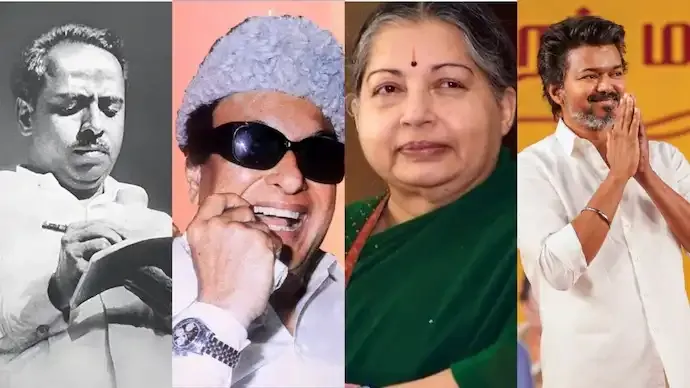

Tamil Nadu occupies a singular position in India’s political landscape, where cinema has long functioned as more than entertainment—it has been a powerful vehicle for ideology, mass mobilisation, and leadership building. From the mid-20th century to the present day, the state has repeatedly witnessed film personalities transition into political authority, shaping governance, public discourse, and electoral outcomes. With the censor controversy surrounding Jana Nayagan and renewed focus on actor Vijay’s political ambitions, this unique cinema-politics continuum has once again come into sharp focus.
The roots of this phenomenon lie in the Dravidian movement, which recognised early that cinema could communicate political ideas more effectively than conventional campaigning. CN Annadurai, founder of the Dravida Munnetra Kazhagam (DMK), was among the first to harness cinema as an ideological tool. As a prolific screenwriter and orator, Annadurai embedded rationalism, anti-caste thought, and self-respect ideology into popular films, allowing political messaging to reach households across Tamil Nadu.
This strategy reached its creative and political peak under M Karunanidhi, whose screenplay for Parasakthi transformed Tamil cinema into a platform for social and political awakening. His mastery of dialogue-driven storytelling helped translate Dravidian ideology into mass consciousness, eventually propelling him to multiple terms as Chief Minister.

If Karunanidhi demonstrated cinema’s ideological power, MG Ramachandran proved its electoral potency. MGR’s carefully cultivated on-screen image as a saviour of the poor seamlessly merged with his political persona. When he founded the AIADMK, his cinematic popularity translated into immediate mass appeal, establishing a template where star power could directly convert into votes.
That template was refined by J Jayalalithaa, whose rise defied both political and gender barriers. Unlike MGR’s populist heroism, Jayalalithaa projected authority, discipline, and control. Despite intense personal and political attacks, she emerged as one of Tamil Nadu’s most dominant leaders, proving that cinema-origin politicians could command power independently rather than merely inherit it.
Not all cinematic legends succeeded politically. Sivaji Ganesan’s unsuccessful political foray highlighted a crucial lesson: artistic brilliance does not automatically translate into political credibility. Later entrants such as Vijayakanth, Sarathkumar, Kamal Haasan, and Rajinikanth further illustrated the evolving limits of celebrity politics in an increasingly complex electoral environment.
Against this backdrop, Vijay represents the latest and perhaps most consequential test of Tamil Nadu’s cinema-politics tradition. His political party, Tamilaga Vettri Kazhagam (TVK), and the symbolism surrounding Jana Nayagan have intensified speculation about whether cinematic influence can still reshape leadership in the digital age.
Unlike earlier eras dominated solely by cinema halls, today’s political battlefield includes social media, fragmented audiences, and heightened scrutiny. Vijay’s challenge will not lie in popularity alone, but in building organisational depth, articulating ideological clarity, and navigating governance realities beyond the screen.
As Tamil Nadu moves toward the 2026 Assembly elections, the state’s storied cinema-to-politics journey stands at a crossroads—caught between a powerful legacy and a rapidly changing democratic landscape.






Conversation
Be kind and stay on topic. Comments are moderated; abuse, spam and personal attacks are removed. Report a problem