



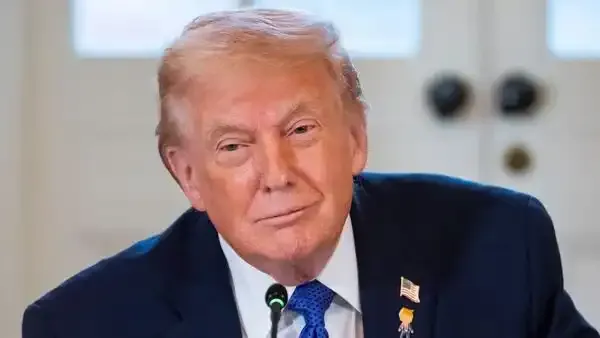
Global financial markets turned cautious after Donald Trump announced fresh tariff threats against several European countries, linking the move to their refusal to engage with Washington over his push to acquire Greenland. The unexpected geopolitical framing of the trade action unsettled investors, triggering a retreat from risk-heavy assets and sending the US dollar lower.
Trump said the United States would impose a 10 per cent tariff from February 1 on imports from Denmark, Norway, Sweden, Finland, Germany, France, Netherlands, and the United Kingdom. He warned the duties would rise to 25 per cent from June 1 if no agreement is reached, explicitly tying the tariffs to Greenland—a move that has alarmed European capitals.
Market reaction was swift. Asian and European equities opened lower as investors reduced exposure to stocks, while US futures pointed to a guarded start on Wall Street. The sell-off reflected concerns that reopening a US-Europe trade dispute could disrupt supply chains, increase import costs, and weigh on already fragile global growth.

Currency markets also reflected rising risk aversion. The dollar weakened as traders rotated into perceived safe havens, including the Japanese yen and the Swiss franc. Gold attracted renewed buying interest, a typical response when geopolitical uncertainty increases and confidence in risk assets wanes.
European leaders criticised the Greenland-linked tariff threat as destabilising, warning that retaliation would be considered if the measures are implemented. Officials signalled that coordinated responses are being discussed within the European Union, raising the prospect of counter-tariffs or other defensive actions. Such steps, analysts caution, could amplify market volatility and deepen the standoff between two of the world’s largest economic blocs.
Investors are particularly uneasy about the precedent of tying trade policy to a geopolitical demand. Market participants say this adds a layer of unpredictability to policy-making, complicating risk assessment and corporate planning. The uncertainty is compounded by the staggered timeline—near-term tariffs followed by a higher rate later in the year—keeping markets on edge as deadlines approach.
For now, traders are closely monitoring signals from Washington and Brussels to gauge whether the rhetoric will translate into action or give way to negotiation. Past trade disputes have sometimes ended with last-minute compromises, but the explicit linkage to Greenland has made this episode harder to price.
Until clarity emerges, caution is likely to dominate global trading. Equities may remain under pressure, safe-haven demand could persist, and the dollar may stay soft if policy risks escalate. With tariff dates looming, markets appear braced for choppy conditions as investors await the next move in a standoff that blends trade, geopolitics, and uncertainty.





Conversation
Be kind and stay on topic. Comments are moderated; abuse, spam and personal attacks are removed. Report a problem