

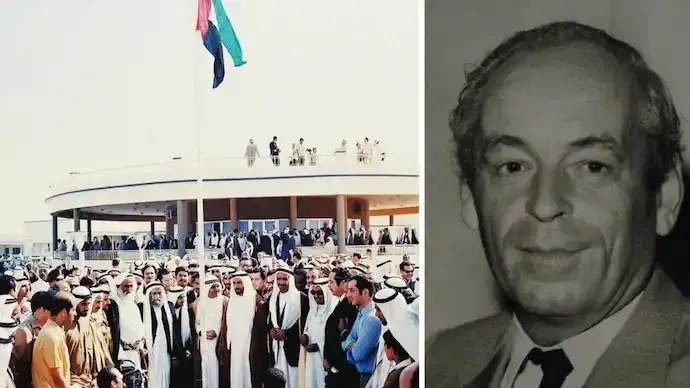

Before becoming a unified nation, the United Arab Emirates existed as a group of loosely connected territories known as the Trucial States. These seven sheikhdoms had no clearly defined borders and were shaped by tribal loyalties rather than formal maps.
The transformation into a modern nation required not just political vision but also geographical clarity — a task that would be undertaken in an unusual and challenging way.
Role of British Diplomat Julian Walker
Julian Walker played a crucial role in defining the modern map of the UAE. Unlike traditional mapping methods, Walker physically travelled across the harsh desert terrain in a Land Rover, documenting tribal regions and boundaries.

His approach involved direct engagement with local tribes, understanding their influence, and translating these dynamics into geographical lines on paper.
Mapping Through Tribal Understanding
At the time, borders were not marked by physical boundaries but by tribal affiliations and influence. Walker’s work required him to navigate complex social structures, often relying on local knowledge and relationships.
In many cases, his journeys were risky. Entering unfamiliar territories could lead to suspicion, and encounters were sometimes tense. However, patience and diplomacy helped him gather the necessary information.
Challenges of Desert Exploration
Walker’s expeditions were far from straightforward. The desert environment posed significant physical challenges, including extreme weather conditions and difficult terrain.
Additionally, the absence of formal infrastructure meant that much of the mapping relied on observation, interaction, and careful documentation rather than modern surveying tools.
His experiences highlight the unpredictable nature of the region during that time, where hospitality and hostility could both be encountered depending on circumstances.
Foundation for a Unified Nation
The mapping efforts contributed significantly to the formation of the UAE as a unified country. Clear boundaries and understanding of territorial divisions helped facilitate political agreements among the rulers of the seven emirates.
On December 2, 1971, Sheikh Zayed bin Sultan Al Nahyan played a key role in uniting the emirates, marking the birth of the UAE.
Legacy of Early Mapping Efforts
Julian Walker’s work remains an important chapter in the history of the UAE. His unconventional approach to mapping laid the groundwork for a nation that has since become a major global hub.
Today, the UAE stands as a testament to how historical efforts, diplomacy, and local understanding can shape the identity and boundaries of a modern state.





Conversation
Be kind and stay on topic. Comments are moderated; abuse, spam and personal attacks are removed. Report a problem