

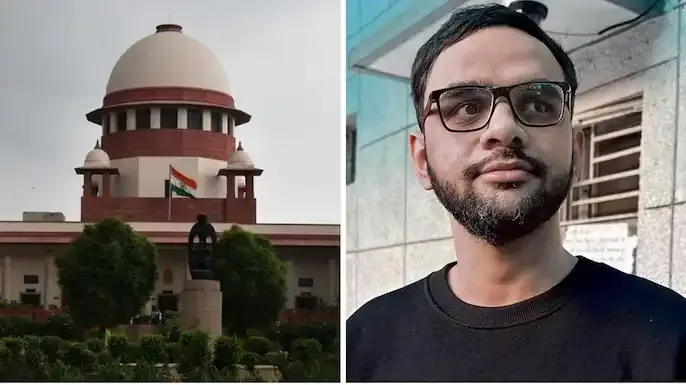

The Supreme Court is set to pronounce its verdict on Monday on bail pleas filed by activist Umar Khalid, scholar Sharjeel Imam, and five other accused in connection with the 2020 north-east Delhi riots case. The ruling comes after nearly five years of incarceration and prolonged legal proceedings under the Unlawful Activities (Prevention) Act (UAPA), making it one of the most closely watched decisions in recent years.
The case stems from the communal violence that erupted in February 2020 amid protests against the Citizenship Amendment Act (CAA) and the proposed National Register of Citizens (NRC). The riots claimed 53 lives and left more than 700 people injured, prompting the registration of over 750 FIRs across Delhi. Investigating agencies have alleged that the violence was the outcome of a larger, premeditated conspiracy rather than spontaneous unrest.
A bench of Justices Aravind Kumar and N.V. Anjaria of the Supreme Court of India reserved its verdict last month after marathon hearings that saw detailed arguments from both the prosecution and the defence. The accused have challenged a September 2023 order of the Delhi High Court, which denied bail while describing their alleged roles as “grave” and central to the conspiracy.

The prosecution has consistently argued that the accused were part of a deep-rooted and “pan-India” plot aimed at destabilising the state. According to the Delhi Police, protest networks, messaging groups and student organisations were allegedly used to mobilise crowds, block roads, and escalate tensions at a time when international attention was focused on India due to a high-profile foreign visit. Investigators have relied on witness statements, electronic records, chat messages and call data to support their claims.
Opposing bail, the police also rejected arguments of trial delay, asserting that adjournments were often caused by the accused themselves. It maintained that the trial could be concluded within a reasonable timeframe if proceedings moved without obstruction, and said only a limited number of witnesses were crucial to proving the case.
The defence, however, has strongly contested these claims. Lawyers representing the accused have argued that there is no direct evidence linking their clients to acts of violence or riot instigation. They have stressed that the case remains at the stage of framing of charges despite a voluminous chargesheet and nearly 900 listed witnesses, making early conclusion of the trial unlikely. According to the defence, prolonged incarceration without conviction violates the fundamental right to personal liberty.
The bail pleas have also attracted political and international attention. Civil liberties groups and foreign lawmakers have raised concerns over extended pre-trial detention under stringent anti-terror laws, while the government has dismissed such commentary as external interference. Political reactions within India have remained sharply divided along ideological lines.
The Supreme Court’s decision is expected to have far-reaching implications beyond the fate of the seven accused. Legal experts say the verdict could influence future jurisprudence on how courts balance national security concerns with individual liberty under the UAPA, particularly in cases involving long incarceration and delayed trials.
As the apex court prepares to deliver its ruling, the outcome is being closely watched for its legal, political and constitutional significance in one of the most complex cases arising from the 2020 Delhi riots.





Conversation
Be kind and stay on topic. Comments are moderated; abuse, spam and personal attacks are removed. Report a problem