

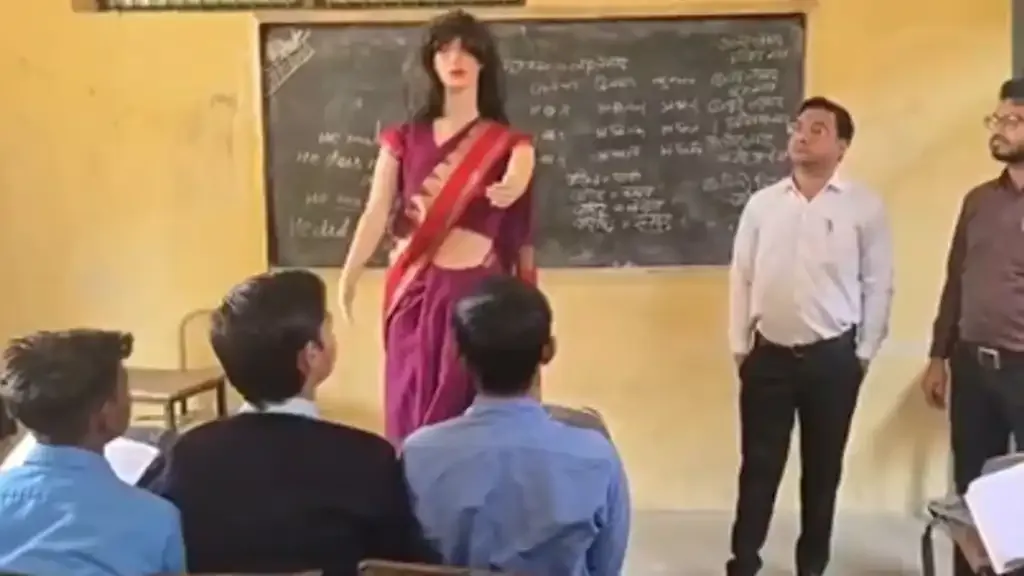

A Class 12 student from Bulandshahr, Uttar Pradesh, has captured national attention after developing an AI-powered teacher model named Sophie. The classroom demonstration, recorded at Shiv Charan Inter College, quickly went viral on social media, drawing praise for creativity and raising questions about how such systems function.
Seventeen-year-old Aditya Kumar showcased Sophie using a mannequin paired with an AI voice assistant. In the viral clip, posted by ANI, Sophie introduces herself, interacts with students, and answers general knowledge questions accurately — including naming Dr Rajendra Prasad as India’s first President and Jawaharlal Nehru as the first Prime Minister.
Teachers and students appreciated the initiative, calling it an encouraging example of self-driven STEM exploration.

Not a True ‘Robot’: What the System Likely Uses
While being described as a robot, Sophie appears to operate as a mannequin integrated with an LLM-powered voice assistant. Experts and social media users pointed out that:
-
The model does not contain a standalone ‘LLM chipset’, as such chips do not exist.
-
Large Language Models like ChatGPT or Gemini run on cloud-based GPU clusters, not on small hardware boards.
-
Classroom “robots” typically rely on:
-
Microcontrollers like Arduino, ESP32, Raspberry Pi Pico
-
SBCs such as Raspberry Pi
-
AI-focused boards like Jetson Nano/Orin Nano
-
WiFi-enabled modules connecting to an online AI API
-
In such setups, speech input is sent to a cloud LLM, while the mannequin serves as the physical interface. Preprogrammed servo or stepper motors usually control basic movements like head turns or hand gestures.
Viral Demo Sparks Discussion on AI in Education
The video has triggered a wider conversation about student-led innovation in robotics and AI. Teachers at the school praised Aditya’s ingenuity, emphasising the need for district-level research labs to support such talent.
The trend reflects a growing interest in AI and STEM among Indian students, even in regions without advanced facilities.
Kerala’s AI Teacher Inspiration
The viral project follows Kerala’s launch of Iris, India’s first generative AI teacher, introduced in 2024. Developed by Makerlabs Edutech, Iris was deployed at KTCT Higher Secondary School in Thiruvananthapuram as a humanoid capable of personalised instruction.
Aditya’s project is seen as part of this emerging wave of school-level AI experimentation across India.






Conversation
Be kind and stay on topic. Comments are moderated; abuse, spam and personal attacks are removed. Report a problem