



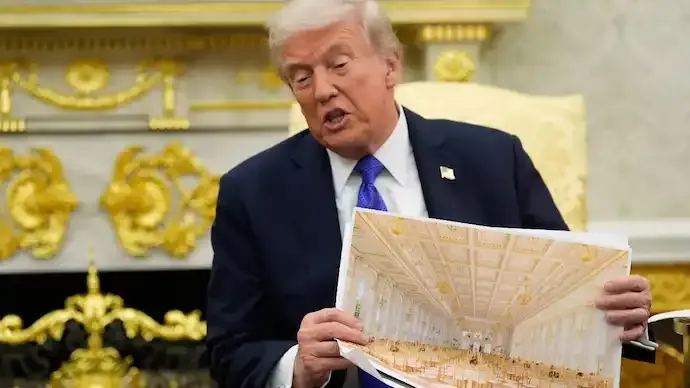
The US Supreme Court has temporarily allowed President Donald Trump’s administration to continue construction on its controversial $400 million White House ballroom project, pausing a lower court order that would have halted much of the work.
The decision, issued as an administrative stay, does not settle the larger legal dispute over whether the Trump administration can proceed with the massive overhaul without explicit approval from Congress.
Chief Justice John Roberts issued the temporary stay, allowing construction to continue while the Supreme Court considers the administration’s request and the legal challenge moves forward.

Supreme Court Temporarily Pauses Lower Court Order
The dispute began after the National Trust for Historic Preservation challenged the Trump administration over the demolition of the White House East Wing and the construction of a planned 90,000-square-foot ballroom.
A lower court had ordered the administration to halt above-ground construction, while allowing certain underground work and security-related activity to continue.
The US Court of Appeals for the District of Columbia Circuit later upheld that order in a 2-1 decision. The order was set to take effect before the Supreme Court intervened.
The appeals court questioned whether a sitting president could fundamentally reshape the White House without congressional approval, stressing that the building is a national institution rather than the personal property of any administration.
Why Is Trump’s White House Ballroom Project Controversial?
Trump’s proposed project is far larger than a conventional renovation.
The administration has described the development as an integrated complex that includes a ballroom as well as underground security infrastructure. According to the Justice Department, the project is intended to include facilities related to emergency protection and White House security.
Trump has argued that the project is necessary for national security, while the Justice Department told the Supreme Court that halting construction would disrupt work on what it described as an integrated military and security complex.
The administration has said the overall East Wing project, including the underground facilities and ballroom, is already around 65% complete.
National Trust Challenges Construction Without Congress Approval
The National Trust for Historic Preservation has argued that the Trump administration does not have the legal authority to undertake such a major transformation of the White House without approval from Congress.
The preservation group filed its lawsuit after the East Wing was demolished and construction began on the new complex.
Its lawyers have maintained that previous courts examining the dispute concluded that the administration could not unilaterally move forward with the project without congressional authorisation.
The Supreme Court's latest action, however, is only temporary and does not represent a final judgment on those arguments.
Trump Welcomes Supreme Court Intervention
Trump welcomed the Supreme Court's decision, describing the planned complex as an important national security project.
He has repeatedly defended the ballroom and broader East Wing redevelopment, previously calling the structure a security necessity and criticising lower court decisions that attempted to restrict construction.
The administration has argued that delays could interfere with the broader security infrastructure planned for the White House.
What Happens Next?
The Supreme Court will now consider whether the Trump administration should be allowed to continue construction while the underlying legal challenge proceeds.
For now, the administrative stay means work on the White House ballroom project can continue.
However, the central question remains unresolved: Can a US president authorise such a significant reconstruction of the White House without explicit approval from Congress?
The Supreme Court's future decision could determine not only the fate of Trump’s $400 million ballroom project but also clarify the limits of presidential authority over major changes to one of America's most important public buildings.







Conversation
Be kind and stay on topic. Comments are moderated; abuse, spam and personal attacks are removed. Report a problem