

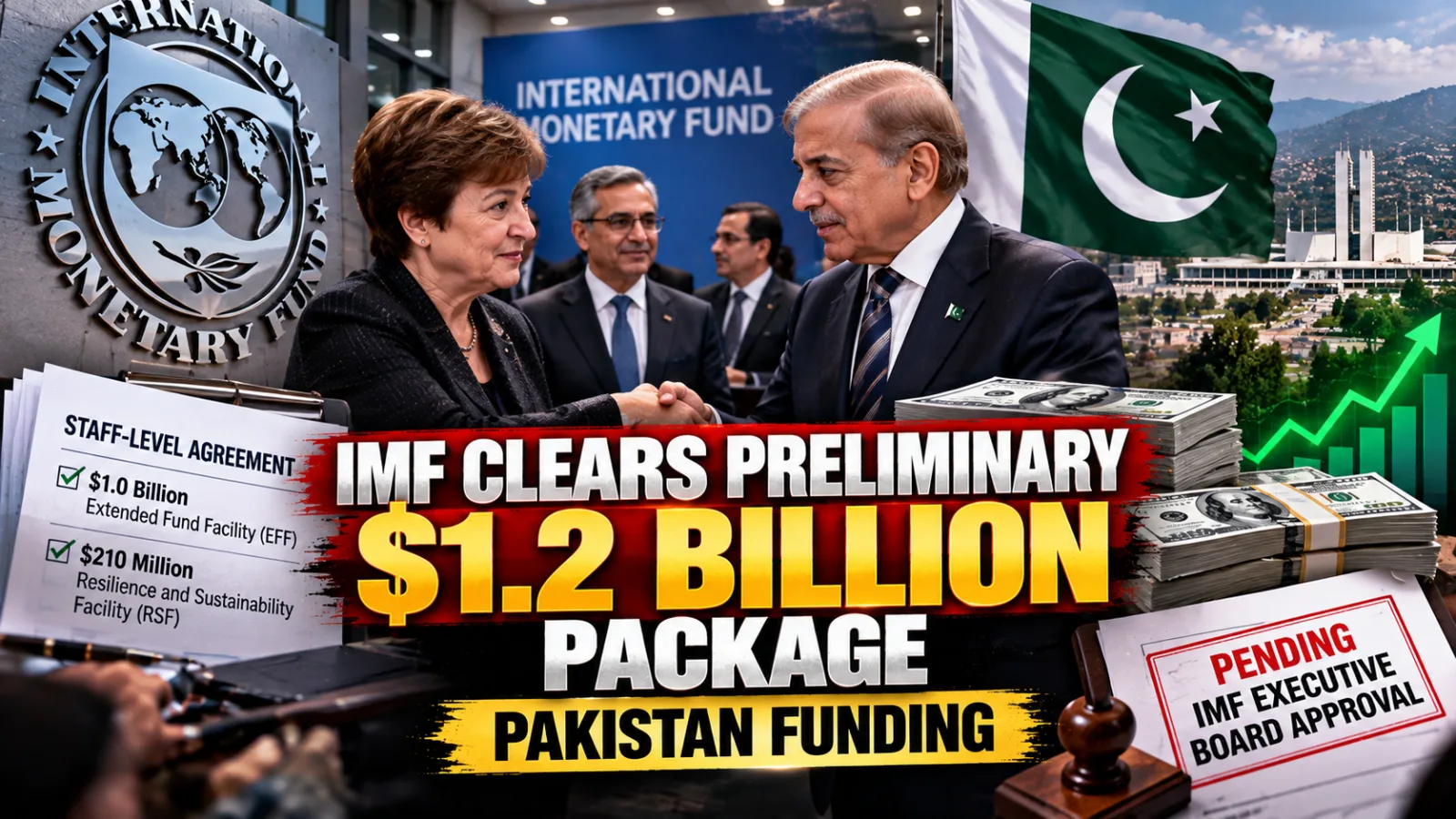

The IMF Pakistan $1.2 billion package has moved closer to approval after the International Monetary Fund reached a staff-level agreement with Pakistani authorities for fresh funding. The proposed amount includes around $1 billion under the IMF’s main loan programme and another $210 million under a separate facility designed to help Pakistan address climate and other long-term risks.
The agreement remains provisional and must be approved by the IMF Executive Board before the funds can be released.
IMF Agreement Covers Two Programmes
The staff-level agreement was reached after discussions between an IMF team led by Iva Petrova and Pakistani authorities.

It covers the fourth review of Pakistan’s 37-month Extended Fund Facility and the third review of the country’s 28-month Resilience and Sustainability Facility.
If approved, Pakistan would receive approximately $1 billion, equivalent to SDR 760 million, under the EFF and around $210 million, or SDR 154 million, under the RSF.
The approval would take total disbursements under the two programmes to approximately $5.7 billion.
A staff-level agreement is a provisional understanding reached between an IMF negotiating team and a member government. It does not represent final approval of the funding.
Pakistan’s Economy Shows Signs of Stabilisation
According to the IMF assessment cited in the announcement, Pakistan’s economy has maintained some recent stability despite external pressures.
Real GDP growth reached 4% during the first three quarters of FY26, while full-year growth was estimated at 3.6%. The IMF said higher energy prices and supply disruptions had weakened momentum.
Headline inflation moderated to around 10.3% in September after reaching a peak in May, while core inflation remained contained.
Pakistan’s current account was broadly balanced during FY26, helped by strong remittances. Gross foreign exchange reserves also increased to around $21 billion by the end of September.
The IMF said sovereign rating upgrades and renewed access to international markets pointed towards improved policy credibility.
External Risks Remain High
Despite the improvement in several economic indicators, the IMF warned that Pakistan continues to face significant external risks.
These include geopolitical tensions, volatile energy prices, tighter global financial conditions and disruptions to international trade.
The IMF also said Pakistan had managed the impact of the West Asia conflict with support from the existing programme and strong economic policies.
The proposed $1.2 billion funding package therefore comes as Pakistan attempts to maintain macroeconomic stability while dealing with a challenging global economic environment.
Final disbursement remains subject to approval by the IMF Executive Board.







Conversation
Be kind and stay on topic. Comments are moderated; abuse, spam and personal attacks are removed. Report a problem