

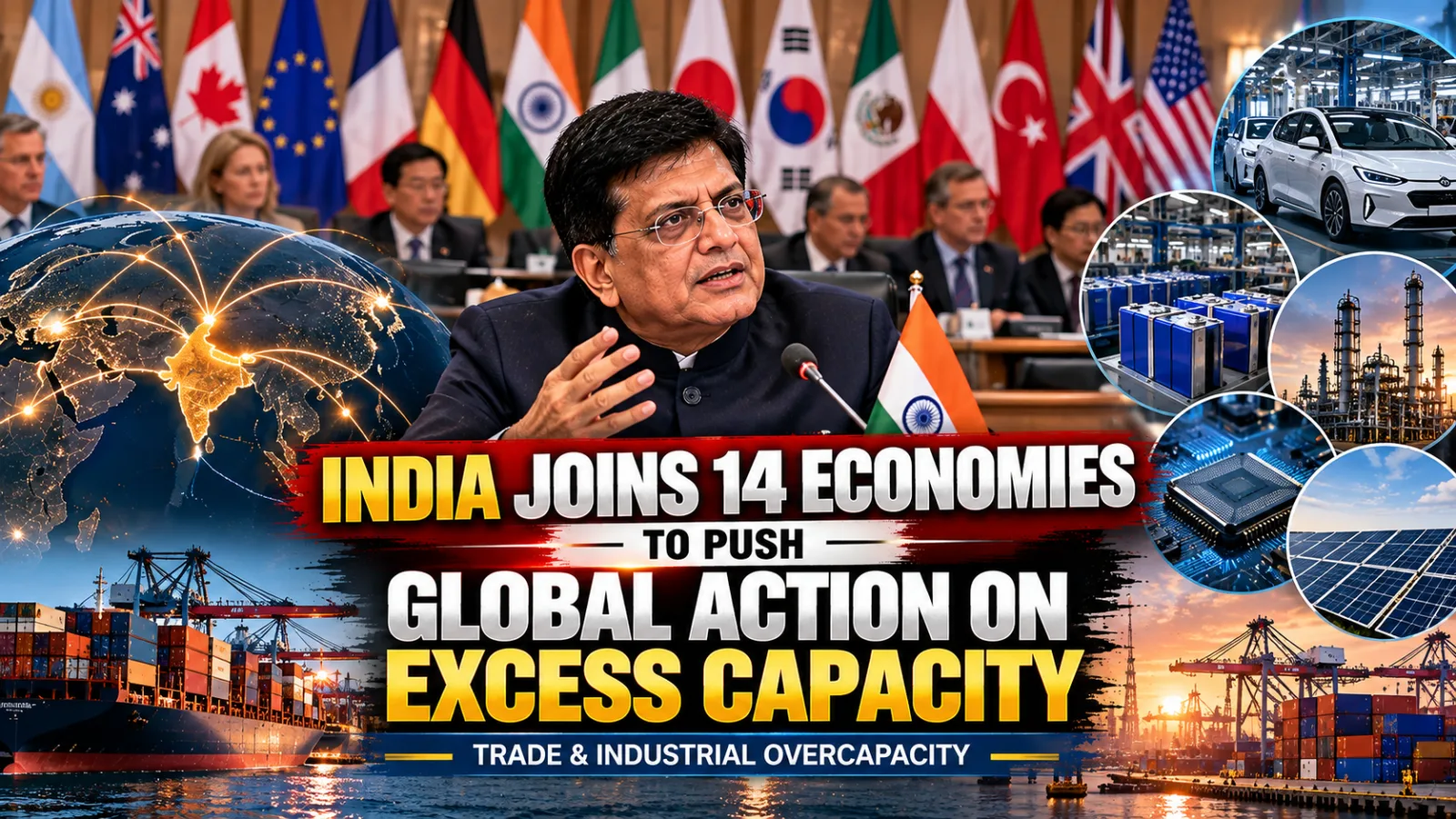

Excess industrial capacity has emerged as a major global trade concern after India joined 14 other economies in calling for coordinated action to address production that exceeds demand and distorts markets. The joint position was announced in Washington following discussions held alongside the Organisation for Economic Co-operation and Development Trade Committee deliberations.
The participating economies called on countries to remove structural excess capacity and production, including by ending non-market policies and practices that contribute to market distortions.
15 Economies Back Coordinated Action
India joined Argentina, Australia, Canada, the European Union, France, Germany, Italy, Japan, South Korea, Mexico, Poland, Turkiye, the United Kingdom and the United States in signing the joint statement.

The countries agreed to work through dedicated sectoral platforms to examine structural excess capacity in key industries and develop coordinated responses.
The initiative builds on discussions held during the G20 Trade Ministerial in Milwaukee, where excess industrial capacity was among the issues that failed to achieve consensus across the wider grouping.
The joint statement said structural excess production can create an imbalance between global supply and demand, while affecting domestic industries and local production.
Major G20 Economies Stay Outside Statement
The latest agreement also highlights divisions within the G20.
China, Brazil, Indonesia, Russia, Saudi Arabia and South Africa did not sign the statement. The G20 trade ministerial in Milwaukee had previously failed to reach consensus on issues including forced labour and excess industrial capacity.
The absence of several major economies means the latest initiative represents a coordinated position among the 15 signatories rather than a unified G20 agreement.
US Trade Representative Jamieson Greer said several economies had raised concerns about production exceeding global demand and the role of government policies and practices in sustaining such capacity.
He warned that leaving the issue unaddressed could put pressure on domestic industries and local production.
India Joins Broader Trade Policy Push
For India, participation in the initiative comes as major economies increasingly debate how to respond to industrial production that outpaces global demand.
The joint statement focuses on coordinated action and sector-specific discussions rather than announcing immediate tariffs or other individual trade measures.
The signatories will therefore use the proposed platforms to examine areas of concern and consider measures aimed at addressing structural excess capacity.
The move also underlines the growing differences within the G20 over industrial policy and trade practices, with 15 economies now seeking a coordinated international response while several other major G20 members remain outside the initiative.






Conversation
Be kind and stay on topic. Comments are moderated; abuse, spam and personal attacks are removed. Report a problem