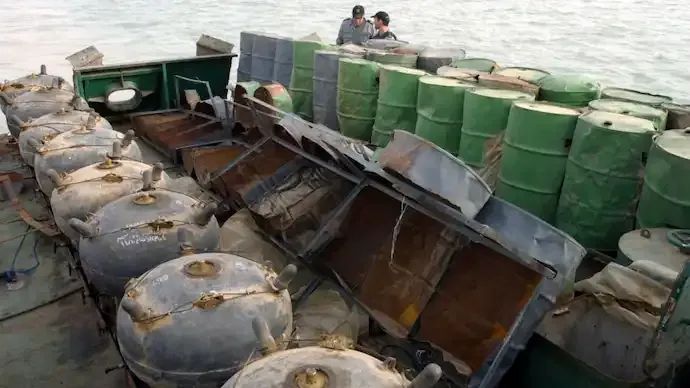
Rising tensions in the Middle East have brought global attention to the strategic waters of the Strait of Hormuz, after Iran announced plans to deploy hundreds of sea mines in the area. The move has sparked concerns among global shipping companies, energy markets and maritime security experts because the narrow strait is one of the world’s most important oil transit routes.
The Strait of Hormuz connects the Persian Gulf with the Arabian Sea and is used to transport nearly one-fifth of the world’s oil supply. Any disruption in this passage can significantly affect global energy markets and shipping operations.
What Are Sea Mines
Sea mines, also known as naval mines, are explosive devices designed to damage or destroy ships and submarines. They are usually placed underwater and can remain hidden for long periods, making them difficult to detect.
These weapons can be triggered in several ways. Some explode when a ship physically touches the mine, while others are activated by changes in magnetic fields, pressure or acoustic signals created by passing vessels.
Sea mines are considered one of the most cost-effective naval weapons because they can disrupt maritime traffic even when deployed in relatively small numbers. A few mines placed in strategic waterways can force shipping companies to change routes or halt operations altogether.
Why Iran Is Announcing the Deployment
Typically, naval mines are deployed secretly so that enemy ships encounter them unexpectedly. However, analysts say Iran’s decision to publicly announce the deployment of sea mines is part of a broader psychological and economic strategy.
By declaring its intention openly, Iran sends a warning to international shipping companies, insurers and governments that navigation through the Strait of Hormuz could become risky. This can increase shipping insurance costs and cause vessels to avoid the area, even if only a limited number of mines are actually deployed.
Security experts believe this tactic allows Iran to create a deterrence effect without necessarily closing the shipping route completely. The announcement alone can influence global energy markets and create uncertainty in international trade.
Impact on Global Energy Trade
The Strait of Hormuz is one of the most critical chokepoints in global energy supply chains. Major oil exporters in the region, including Saudi Arabia, United Arab Emirates and Kuwait, rely heavily on this route to transport crude oil to global markets.
If sea mines are deployed in significant numbers, ships carrying crude oil and liquefied natural gas could face serious navigation risks. This could lead to delays in shipments, higher transportation costs and increased volatility in global oil prices.
Psychological Impact on Shipping Industry
Naval mines have historically had a powerful psychological impact on maritime operations. Even the possibility that mines may be present can force shipping companies to slow down, reroute vessels or suspend operations until waterways are declared safe.
Insurance companies also tend to increase war risk premiums when naval mines are suspected in strategic waterways. This further raises the cost of transporting oil and other cargo through affected areas.
Growing Security Concerns in the Region
The announcement about sea mine deployment comes at a time of escalating tensions between Iran and its regional adversaries following military strikes and geopolitical confrontations in the region.
Maritime authorities and international naval forces are closely monitoring developments in the Strait of Hormuz to ensure the safety of commercial vessels. Any confirmed mining activity could lead to expanded naval patrols and mine-clearing operations.
As global energy markets remain sensitive to developments in the region, the situation around the Strait of Hormuz continues to be closely watched by governments, shipping companies and investors worldwide.
Prev Article
Iran Regime Stable Despite US-Israel Strikes, Intelligence Assessments Say
Next Article
Jeffrey Epstein’s Former Accountant Says He Was Unaware of Sex Crimes