

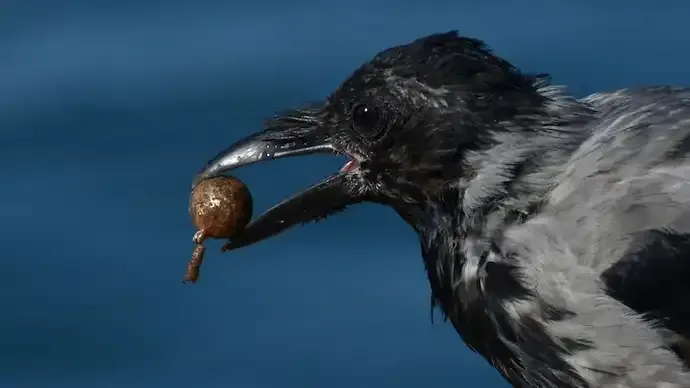

In many urban homes, the pattern begins quietly. Food is left on a balcony or ledge. A crow notices. The exchange continues for days. Then one morning, beside the empty plate, lies a pebble, a bottle cap or a small shiny object. For many people, it feels personal — almost like a thank-you.
While the moment may seem mysterious or symbolic, scientists say this behaviour highlights something far more compelling: the exceptional intelligence and memory of crows.
What Science Reveals About Crow Intelligence
Crows belong to the corvid family, widely regarded as one of the most intelligent bird groups in the animal kingdom. Research has shown that they can solve complex puzzles, use tools, plan future actions and remember detailed social information.

A peer-reviewed study published in the Proceedings of the National Academy of Sciences found that American crows can recognise individual human faces and remember them for years. In controlled experiments, crows reacted strongly to specific masks worn by researchers who had previously handled them, even long after the initial encounter. Humans perceived as kind and those seen as threatening were remembered differently.
This long-term memory plays a crucial role in how crows interact with people who regularly feed or protect them.
Are Crows Actually Giving Gifts?
Scientists are cautious about describing the behaviour as “gift-giving.” There is no evidence that crows experience gratitude in the human sense. Instead, animal behaviour researchers point to a process known as learned exchange.
Crows naturally collect objects that are shiny, unusual or easy to carry. When approaching a familiar feeding spot, a crow may drop an object it is holding. If that action is followed by food or a non-threatening human response, the bird may repeat the behaviour. Over time, this creates a consistent pattern that resembles an exchange.
Ethologists also note that crows learn by observation. Once one bird successfully repeats a behaviour, others in the group may imitate it, allowing the habit to spread within a local population.
Why the Objects Look Familiar
The items people find — pebbles, metal pieces, bottle caps or rings — share common traits. They are durable, lightweight and visually striking, making them attractive to crows during exploration.
What appears to be a deliberate message is more accurately a sign of memory, curiosity and growing trust.
What This Behaviour Truly Indicates
Even without attributing human emotions to birds, the behaviour reveals something remarkable. Crows can recognise individual humans, remember past interactions and adjust their actions based on experience.
That ability places them among the most cognitively advanced animals living alongside humans in cities. In an environment where human–wildlife interactions are often strained, these small exchanges highlight how behaviour — and trust — can evolve across species.









Conversation
Be kind and stay on topic. Comments are moderated; abuse, spam and personal attacks are removed. Report a problem