
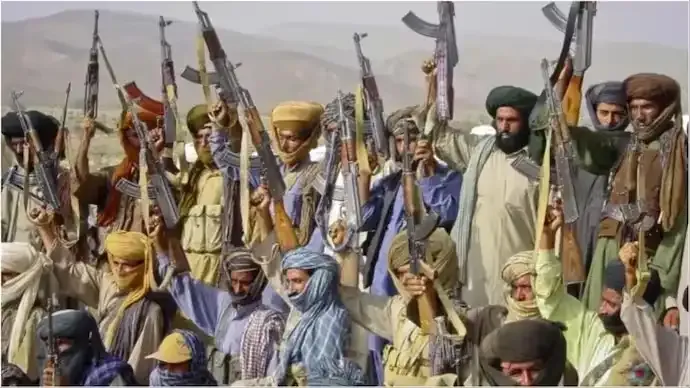
Pakistan’s restive Balochistan province witnessed one of the largest and most coordinated militant offensives in decades, as Balochistan Liberation Army (BLA) rebels launched simultaneous suicide bombings and armed attacks across multiple districts. The scale and sophistication of the assault have not only shaken Pakistan’s internal security apparatus but also sent a clear warning signal to two major global stakeholders in the region: the United States and China.
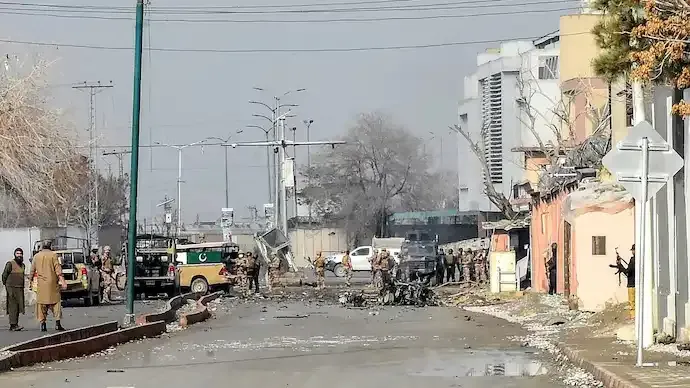
The coordinated strikes, carried out under what the BLA described as the second phase of its operation “Herof” or “black storm,” targeted civilians, police stations, military and paramilitary installations, transport infrastructure, and government buildings. Reports indicate that attacks took place across a wide geographical spread, including Quetta, Gwadar, Mastung, Noshki, Kalat, Panjgur, Turbat, Pasni, Kech, Awaran and several other locations, paralysing large parts of the province.
Security and intelligence sources in Quetta suggested that between 800 and 1,000 BLA fighters may have been involved in the operation, making it one of the most extensive militant offensives in Balochistan in recent memory. While casualty figures vary, provincial authorities confirmed that dozens of civilians and security personnel were killed. The Pakistani military claimed it eliminated over 140 militants during subsequent counter-operations, though the BLA disputed these numbers and issued its own claims.
Beyond the immediate violence, the attacks underline a deeper geopolitical message. Despite being Pakistan’s largest province by area, Balochistan remains economically underdeveloped while holding immense strategic and resource value. It borders Iran and Afghanistan, provides access to the Arabian Sea, and hosts Gwadar port — a critical node in regional trade and energy routes.
Balochistan’s significance has grown sharply in recent years due to rising foreign interest in its natural wealth. The province is rich in natural gas, copper, gold, coal, and rare earth minerals, making it central to Pakistan’s economic ambitions and foreign investment strategies. Both China and the US have increased their engagement in the region, primarily driven by resource extraction and alternative trade corridors.
For China, Balochistan is a cornerstone of the China–Pakistan Economic Corridor (CPEC), a flagship project under Beijing’s Belt and Road Initiative. Gwadar port and the road-rail network passing through Balochistan are designed to provide China with shorter and more secure access to Middle Eastern energy supplies, bypassing vulnerable maritime chokepoints.
The United States, meanwhile, has shown growing interest in Balochistan’s critical minerals. Recent announcements include major investments and memorandums of understanding aimed at mining and refining copper, gold, and rare earth elements in the province — resources vital for advanced technologies and energy transitions.
However, these expanding economic ambitions intersect directly with the core grievances driving the Baloch insurgency. One of the BLA’s longstanding claims is that Balochistan’s resources are exploited by Islamabad and foreign powers while offering little benefit to the local population. Despite contributing significantly to Pakistan’s energy and mineral output, Balochistan remains the country’s poorest province, with low royalties and limited development reaching its people.
This perception of extraction without inclusion has intensified resentment and fuelled militancy. Attacks on Chinese engineers and infrastructure projects in recent years underline the BLA’s opposition to foreign involvement, particularly when linked to resource exploitation.
The latest wave of violence makes it clear that security risks in Balochistan are inseparable from economic and geopolitical interests. For both Washington and Beijing, the attacks serve as a stark reminder that investments and strategic projects in the province cannot move forward without addressing local grievances, governance failures, and long-standing political discontent. Ignoring these realities may only deepen instability in a region that is increasingly central to global economic and strategic calculations.


Conversation
Be kind and stay on topic. Comments are moderated; abuse, spam and personal attacks are removed. Report a problem