

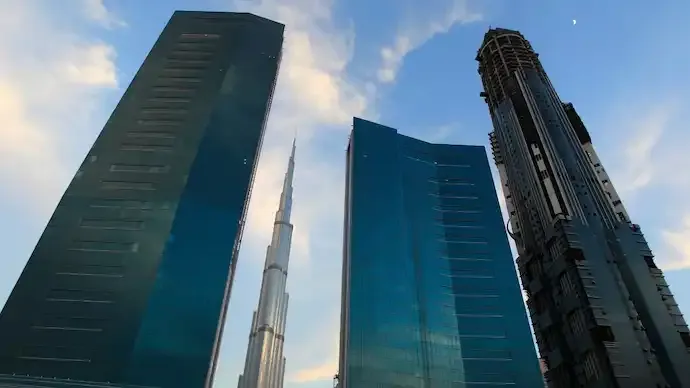

Dubai has long positioned itself as a global safe haven for wealth, attracting investors, entrepreneurs and expatriates who invest heavily in the city’s luxury real estate sector. However, rising geopolitical tensions involving Iran and parts of the Gulf are now raising questions about whether regional instability could impact Dubai’s thriving property market.
Recent reports of security incidents in parts of the United Arab Emirates have sparked concerns among global investors about the potential risks associated with geopolitical instability in the region.
Despite these concerns, market analysts believe Dubai’s real estate sector may face short-term caution rather than a major downturn, thanks to strong economic fundamentals and a diversified investor base.

Dubai Entered 2026 With Record Property Growth
Dubai’s property market entered the current geopolitical uncertainty from a position of remarkable strength.
According to industry analysis, the emirate recorded real estate transactions worth nearly AED 917 billion (around $250 billion) in 2025, marking the highest annual value in the city’s history.
More than 270,000 property transactions were completed during the year, highlighting strong investor demand and liquidity in the market.
The residential segment played a major role in this growth. Nearly 200,000 residential deals were recorded in 2025 alone, with a total value estimated at AED 538 billion.
Property prices have also risen significantly since the pandemic recovery. Residential prices in Dubai have increased by 60% to 75% since 2021, making the city one of the fastest-growing housing markets globally.
Geopolitical Tensions May Affect Investor Sentiment
Experts say geopolitical conflicts often influence markets by affecting investor confidence rather than immediately reducing property prices.
When tensions rise, investors typically adopt a wait-and-watch approach, slowing down purchases until the geopolitical environment becomes clearer.
The current conflict introduces a new element because reports of attacks have reached areas within the UAE. Although the physical damage from these incidents has been limited, the psychological impact on international investors could influence short-term decision-making.
Segments such as off-plan property investments and speculative purchases are usually the first to experience slower activity during periods of uncertainty.
Tourism Could Influence Property Demand
Another factor that could shape Dubai’s real estate outlook is tourism.
The broader Middle East tourism sector generates an estimated $367 billion annually. If geopolitical tensions continue for an extended period, travel demand across the region could decline.
Industry projections suggest the region could see 23 million to 38 million fewer visitors, potentially leading to tourism revenue losses between $34 billion and $56 billion.
Such changes could particularly affect short-term rental apartments, hotel properties and retail spaces that rely heavily on tourist activity.
However, Dubai’s real estate demand is not solely dependent on tourism. A large expatriate population continues to create consistent housing demand.
International Investors Support Market Stability
Dubai’s property market is among the most international in the world, with buyers from over 150 nationalities participating in real estate investments.
Expatriates make up nearly 88% to 89% of the UAE’s population, creating strong and sustained demand for residential properties across multiple price categories.
This diverse investor base helps the market remain resilient during periods of global uncertainty.
Indian Investors Play a Major Role
Indian buyers form one of the largest investor groups in Dubai’s real estate sector.
Industry estimates suggest that Indian nationals account for around 20% to 22% of foreign property purchases in the city.
Several factors contribute to this strong participation, including geographic proximity, the stability of the UAE dirham — which is pegged to the US dollar — and attractive rental yields ranging between 6% and 9%.
Indian real estate developers are also expanding their presence in Dubai. While local developers dominate the sector, Indian-origin companies contribute roughly 8% to 10% of the development pipeline.
Lessons From Past Real Estate Cycles
Dubai’s property market has experienced multiple cycles over the past two decades.
During the 2008 global financial crisis, property prices fell sharply by nearly 50% to 60%, and the market took several years to fully recover.
Between 2014 and 2019, prices dropped by around 25% to 30% due to lower oil prices and oversupply in the market.
More recently, the COVID-19 pandemic caused only a temporary slowdown, with the property market rebounding within about 12 to 18 months.
Short-Term Uncertainty, Long-Term Strength
Analysts say the current geopolitical tensions may slow transaction volumes temporarily as investors assess the evolving risks.
However, Dubai’s strong economic position, diversified investor base and role as a global financial hub continue to support long-term demand for property.
Experts believe the key question is not whether geopolitical tensions will affect Dubai’s property market — they likely will in the short term — but how quickly investor confidence returns once the situation stabilises.






Conversation
Be kind and stay on topic. Comments are moderated; abuse, spam and personal attacks are removed. Report a problem