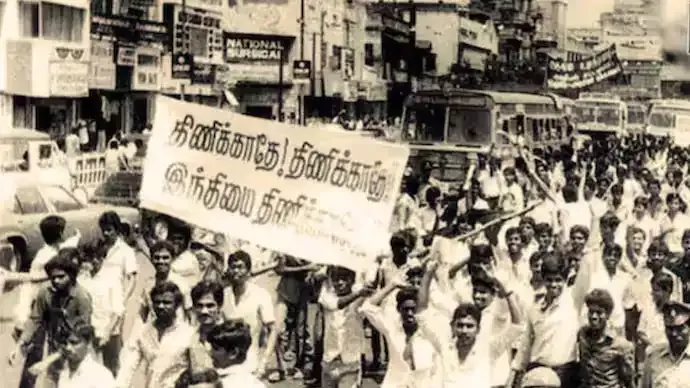
January 26, 1965, unfolded very differently in Madras State, now Tamil Nadu. While the rest of India marked Republic Day with military parades and patriotic celebration, large parts of Madras observed the day in mourning. Black flags fluttered across the city, signalling deep resistance to what many saw as the forced imposition of Hindi as India’s sole official language.
The call for mourning had been issued by the Dravida Munnetra Kazhagam, which described the move toward Hindi-only governance as linguistic domination. The Congress government in the state, led by Chief Minister Bhaktavatsalam, responded with a hard warning, declaring that anyone treating Republic Day as a day of mourning would be considered anti-national. Senior DMK leaders, including C. N. Annadurai, were placed under preventive detention.
What the authorities underestimated was the scale of popular anger. The agitation was no longer confined to political parties. It had become a mass student movement.
India’s language tensions had been simmering for decades. As early as 1937, attempts to make Hindi compulsory in schools of the Madras Presidency had triggered protests. During the Constituent Assembly debates, leaders such as T T Krishnamachari warned that linguistic centralisation could fracture national unity.
The compromise reached in 1949—popularly known as the Munshi–Ayyangar formula—declared Hindi as the official language of the Union while allowing English to continue as an associate language for 15 years, until January 26, 1965. The assumption was that non-Hindi speakers would gradually adapt. Instead, the deadline became a political flashpoint.
For leaders in the Hindi belt, including Morarji Desai, the date symbolised linguistic assertion. For Tamil Nadu’s students and political leaders, it represented cultural erasure and exclusion from national power structures, particularly fears that competitive examinations and administration would soon function only in Hindi.
Protests intensified through 1964 and exploded in January 1965. In Madurai, students marched with placards declaring “Hindi Never, English Ever,” planning symbolic acts against constitutional provisions related to language. Clashes with Congress supporters quickly escalated. Riots spread across the state, transport was paralysed, railway property was damaged, and self-immolations shocked the nation.
By February, Tamil Nadu was engulfed in violence. Official figures put the death toll at nearly 70, while independent estimates suggested it crossed 200. Two Union Cabinet ministers from the state resigned, stating they could not remain part of a government in conflict with its own citizens.
As unrest intensified, Prime Minister Lal Bahadur Shastri struggled to contain the crisis. The turning point came when Indira Gandhi, then a Cabinet minister, travelled to Madras against advice and assured protesters that Hindi would not be imposed. Her intervention helped calm the streets and shift Delhi’s stance.
Soon after, the Centre gave a parliamentary assurance that English would continue indefinitely as an associate official language. This was later codified through the Official Languages Act amendment of 1967, ensuring English would remain until all non-Hindi states agreed otherwise.
The political consequences were profound. In 1967, the DMK swept to power in Tamil Nadu, ending Congress dominance in the state. Since then, governance has alternated between Dravidian parties, reshaping regional politics permanently.
Republic Day 1965 remains a stark reminder that India’s unity was forged not through uniformity, but through accommodation. The fires that burned in Madras forced the nation to acknowledge its linguistic pluralism—an acknowledgment that continues to define India’s democratic fabric.
Prev Article
Operation Sindoor Flypast Showcases India’s Air Power and Tri-Services Integration at Republic Day Parade
Next Article
India Celebrates 77th Republic Day With Global Leaders, Showcases Military Strength and Self-Reliance