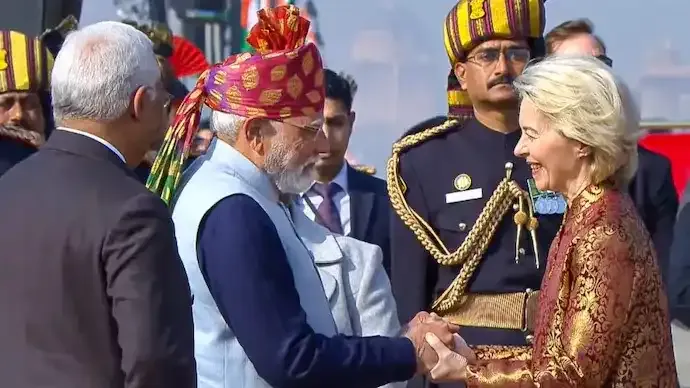
European Commission President Ursula von der Leyen on Monday underlined India’s growing global importance, stating that “a successful India makes the world more stable, prosperous and secure,” as she attended the 77th Republic Day celebrations in New Delhi. Her remarks came at a crucial moment, with India and the European Union poised to conclude negotiations on a long-pending free trade agreement that could significantly reshape bilateral economic ties.
Von der Leyen, accompanied by Antonio Costa, participated in the Republic Day parade as chief guests at Kartavya Path. President Droupadi Murmu took the salute after arriving in a ceremonial buggy with the two European leaders, marking a symbolic display of strengthening India-EU relations.
Sharing her thoughts on social media, von der Leyen described the invitation as a personal honour and highlighted India’s role as a pillar of global stability. Her statement set the tone for high-level discussions scheduled with Narendra Modi at the India-EU summit on January 27, where both sides are expected to formally announce the conclusion of negotiations on the long-awaited free trade agreement.
The proposed pact carries significant economic weight. The European Union is currently India’s largest trading partner, with bilateral goods trade reaching approximately USD 135 billion in the 2023–24 financial year. Officials on both sides believe the agreement could unlock new opportunities across manufacturing, services, technology, green energy, and supply chains, giving a major boost to commercial engagement.
Beyond trade volumes, policymakers view the agreement as a strategic recalibration of India-EU relations. The deal is expected to deepen cooperation across multiple sectors at a time when global trade flows are being disrupted by protectionist policies and tariff uncertainties, particularly from the United States. Growing unease over tariff-driven disruptions has nudged New Delhi and Brussels closer, reinforcing the urgency of economic alignment between the two democracies.
Negotiations for the India-EU free trade agreement were first launched in 2007 but stalled in 2013 due to differences over market access, regulatory standards, and the overall ambition of the pact. Talks were revived nearly a decade later in June 2022, reflecting changing global realities and a renewed willingness on both sides to compromise.
Adding momentum to the talks, reports indicate that India is preparing to make substantial tariff concessions under the agreement. New Delhi is expected to sharply reduce import duties on European cars to 40 per cent from the current peak of 110 per cent. Sources familiar with the negotiations say duties on a limited number of high-end EU vehicles—priced above approximately Rs 16.3 lakh—could be cut immediately, with tariffs gradually falling to 10 per cent over time.
Such a move would mark one of the most significant openings of India’s automobile market and is seen as a key concession aimed at securing the broader deal. European automakers have long sought improved access to the Indian market, while India views the pact as a gateway to greater investment, technology transfer, and export growth.
As leaders prepare to seal the agreement, von der Leyen’s remarks at the Republic Day celebrations underscored the broader narrative driving the negotiations: India’s rise is no longer a regional story, but a global one—one that Europe increasingly sees as central to stability, prosperity, and shared strategic interests.
Prev Article
Indian Air Force Dominance in Op Sindoor Forced Pakistan to Seek Ceasefire: Swiss Study
Next Article
Republic Day Tableaus Highlight Atmanirbhar India and New Penal Laws at Kartavya Path