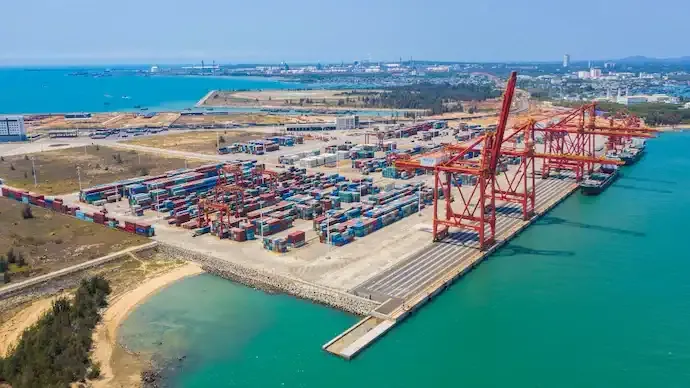
At a time when much of the world is raising trade barriers, China has taken a sharply different route. Beijing has effectively transformed the entire island of Hainan into a unified free-trade zone—an economic experiment nearly 50 times the size of Singapore and almost as large as Taiwan.
The move positions Hainan as China’s most ambitious trade liberalisation project yet, designed to attract foreign companies, reduce costs, and create a duty-free gateway into the Chinese mainland.
Turning an island into a duty-free trade colony
This month, China launched island-wide special customs operations in Hainan, granting zero-tariff eligibility to around 74% of all goods. In effect, Hainan now operates as a separate customs jurisdiction with its own tax, regulatory and trade framework.
Unlike China’s existing free-trade zones—which are usually limited to specific districts or cities—Hainan is being developed as a single, unified free-trade port (FTP) covering the entire island.
Chinese state media has described Hainan as the world’s largest free-trade port by area, offering freer entry for overseas goods, simplified customs procedures and expanded duty-free access.
Why Hainan matters to global companies
The scale and structure of Hainan’s FTP make it especially attractive for international firms:
-
Zero tariffs on nearly three-quarters of imports, up from about 21% earlier
-
Lower operating costs, with import tax savings estimated at around 20%
-
A 30% local value-addition rule, allowing products processed in Hainan to enter mainland China duty-free
-
Corporate tax of 15%, compared to 25% on the mainland and 16.5% in Hong Kong
-
Personal income tax capped at 15% for skilled professionals, far below mainland China’s top rate of 45%
This structure encourages real manufacturing and supply-chain activity rather than simple trans-shipment, pushing companies to add value on the island itself.
Early foreign investment signals confidence
International firms have already begun moving in. On the first day of the new customs regime, Siemens Energy announced a new subsidiary in Hainan and started work on a gas-turbine assembly and service centre in the Yangpu Economic Development Zone.
Over the past five years, Hainan has attracted approximately $14.6 billion in foreign investment, with inflows growing at an average annual rate of 14.6%. Since 2020, more than 8,000 foreign-funded companies from 176 countries and regions have set up operations on the island.
Beijing’s response to global protectionism
Hainan’s transformation comes as the United States and parts of Europe tighten trade rules through tariffs and industrial policy. China, by contrast, is betting that deeper openness—within controlled zones—can revive foreign investment and exports.
China has seen foreign direct investment decline by more than 10% in the first three quarters of 2025. Officials view Hainan as a key pillar of efforts to reverse that trend.
Speaking at the port’s launch, Chinese Vice Premier He Lifeng called the project a “major strategic decision” and urged local authorities to turn Hainan into a gateway for China’s next phase of global economic engagement.
A long-term bet on trade liberalisation
With simplified customs, fewer licensing requirements, faster cross-border trade and strong tax incentives, Hainan is shaping up as China’s boldest trade experiment of the 21st century.
If successful, the island could reshape how international companies access the Chinese market—using Hainan as a cost-efficient, duty-free launchpad—while also signalling Beijing’s intent to counter global protectionism with selective but deep liberalisation.