

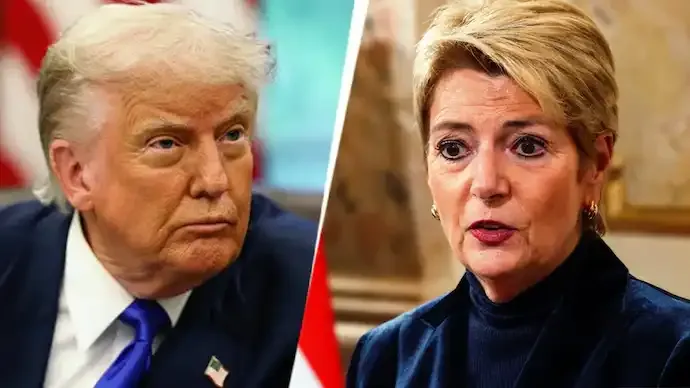

US President Donald Trump has claimed that his decision to increase tariffs on Switzerland was influenced by a tense phone conversation with Swiss Federal Council member Karin Keller-Sutter, highlighting how diplomatic exchanges continue to shape global trade dynamics. The remarks, made during a televised interview, have drawn attention to the personal and political factors behind recent tariff adjustments between the two nations.
According to Trump, he initially imposed a 30 per cent tariff on Swiss imports but later raised it to 39 per cent after what he described as an “aggressive” conversation with the Swiss leader. He said Keller-Sutter repeatedly emphasised that Switzerland is a small country and urged the United States to reconsider the duties. Trump claimed that the repeated appeals during the call influenced his decision not to reduce tariffs but instead increase them.
During the interview, Trump stated that Switzerland runs a significant trade surplus with the United States and argued that the tariff hike was justified to address what he considers an imbalance in bilateral trade. He alleged that Swiss exporters benefited from minimal duties while shipping large volumes of goods into American markets.

The comments have sparked renewed debate about the role of diplomacy and negotiation tone in international economic policy. Observers noted that Switzerland operates under a unique political system governed by a seven-member Federal Council rather than a single prime minister or president, a detail Trump appeared uncertain about in his remarks.
The tariff issue has been unfolding alongside broader global trade negotiations. Analysts point out that tensions between Washington and several European partners have intensified as the US administration pushes for revised trade terms aimed at reducing deficits and encouraging foreign investment in American industries.
Despite the sharp rhetoric, negotiations between US and Swiss officials have continued behind the scenes. Reports indicate that both sides reached a preliminary understanding in November to reduce tariff levels to around 15 per cent, provided that Swiss industries expand investment commitments in the United States over the coming years. The proposed framework reportedly includes plans for substantial long-term investments aimed at strengthening economic cooperation and easing tensions.
Trade experts say Trump’s remarks underline how political messaging can influence markets and diplomatic relations, even when formal negotiations remain ongoing. They also highlight the evolving nature of international trade discussions, where personal interactions between leaders can shape policy decisions alongside economic calculations.
As talks progress, businesses and investors are closely monitoring developments to assess how tariff policies could impact exports, supply chains, and cross-border investments. The coming months are expected to determine whether the two countries can finalise a stable agreement that balances trade interests while reducing the risk of further escalation.






Conversation
Be kind and stay on topic. Comments are moderated; abuse, spam and personal attacks are removed. Report a problem