

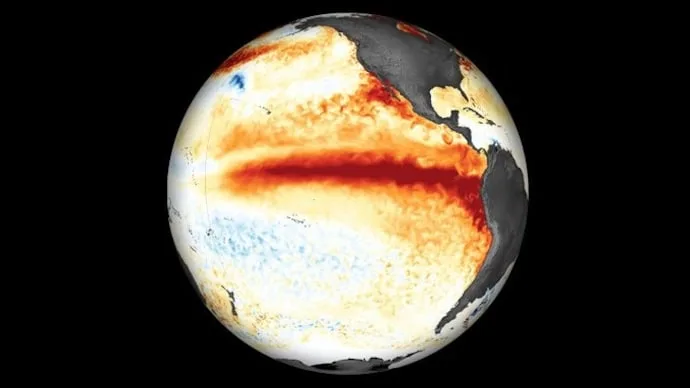

The El Nino Pacific Ocean warming pattern is intensifying, with sea temperatures off Peru reportedly reaching 8.9°C above average at the surface and subsurface temperatures rising as much as 10.5°C above normal. The exceptional warming across the eastern equatorial Pacific has raised concerns about widespread weather disruptions in the coming months.
Sea surface temperature anomalies exceeded 4°C in some parts of the eastern equatorial Pacific last month. In the central Pacific, water warmer than 25°C extended to depths of around 150 metres, indicating that the heat is not limited to the ocean surface.
El Nino Indicators Show Stronger Warming
Several key indicators point to a strengthening El Nino pattern. The Nino-3.4 index, used to monitor conditions across the central equatorial Pacific, reached +2.1°C, while the Nino-3 index climbed to +3.0°C. The Nino-1+2 region, closest to the South American coast, recorded an anomaly of +3.9°C.

These indices measure how much sea surface temperatures differ from long-term averages across specific parts of the equatorial Pacific. Their simultaneous rise indicates stronger interaction between the ocean and atmosphere, which is central to El Nino development.
Atmospheric conditions are also reinforcing the pattern. Unusually strong westerly wind anomalies near the ocean surface and easterly anomalies higher in the atmosphere have extended across the equatorial Pacific.
Rainfall and cloud formation have increased over the central and eastern Pacific, while atmospheric convection remains suppressed over Indonesia.
Subsurface temperatures in the eastern Pacific have also remained significantly above average, reflecting changes in the thermocline, the boundary separating warmer surface water from colder water below.
Historic El Nino Event Could Persist Into 2027
The US Climate Prediction Center's outlook indicates that El Nino is likely to strengthen through the end of 2026 and continue into early 2027.
According to the reported projections, the probability of an event stronger than previous El Nino episodes recorded since 1950 stood at 54% for September-November, 83% for October-December and 70% for November-January.
The outlook also indicated a greater than 83% chance of a strong-to-very-strong El Nino persisting through January-March 2027.
These projections point to the possibility of an unusually powerful event, although forecasts remain subject to change as ocean and atmospheric conditions evolve.
How El Nino Can Disrupt Global Weather
El Nino is a natural climate phenomenon involving warmer-than-average sea surface temperatures across the central and eastern equatorial Pacific. It changes atmospheric circulation and can influence rainfall, temperatures and seasonal weather patterns across different parts of the world.
A strong event can increase the risk of drought in some regions while bringing heavier rainfall to others. Its effects vary depending on geography, season and the interaction with other climate patterns.
For countries dependent on seasonal rainfall, changes in precipitation can affect agriculture, water availability and local economies. However, individual extreme weather events cannot automatically be attributed to El Nino alone.
What Happens Next?
Forecasters will continue monitoring Pacific sea temperatures, atmospheric circulation and updated climate projections to assess the strength and duration of the developing event.
If the warming persists at the projected intensity, its influence could extend across several regions into early 2027. The scale of the eventual impact will depend on how the ocean-atmosphere system evolves and how regional weather patterns respond.





Conversation
Be kind and stay on topic. Comments are moderated; abuse, spam and personal attacks are removed. Report a problem