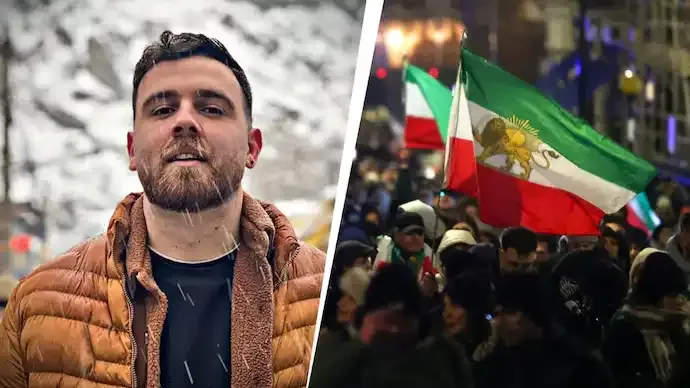
As anti-government protests intensify across Iran, a growing body of reports and eyewitness accounts suggests that the regime of Ayatollah Ali Khamenei has increasingly relied on Arabic-speaking Iraqi Shia militias to suppress dissent, marking a significant escalation in the state’s response to the unrest.
The protests, which began in late December over inflation and economic hardship, have rapidly evolved into a nationwide movement directly targeting Iran’s clerical leadership. Demonstrations have been reported in more than 600 locations across all 31 provinces, with slogans openly calling for regime change. In response, security forces have launched a sweeping crackdown that has resulted in thousands of deaths and mass arrests.
Amid this surge in violence, multiple reports indicate that between 800 and 850 Iraqi Shia fighters have crossed into Iran under the guise of religious pilgrims. These fighters are believed to be affiliated with groups such as Kataib Hezbollah, Harakat al-Nujaba, Badr Organization and Kataib Sayyid al-Shuhada. Their arrival has coincided with a sharp and sudden spike in protester fatalities.
According to border officials and regional sources, dozens of buses carrying young men dressed uniformly crossed from Iraq into Iran through western border points. Unlike typical pilgrimage traffic, these groups reportedly consisted exclusively of fighting-age men, raising suspicions among local officials. By mid-January, nearly 60 such buses had entered Iran, suggesting a coordinated and large-scale mobilisation.
Analysts argue that the deployment of foreign militias reflects growing reluctance within Iran’s own security apparatus to fire on civilians. Reports from rights organisations indicate that some members of the Islamic Revolutionary Guard Corps and the Basij militia have refused orders to shoot protesters, with several allegedly detained for disobedience. Iran’s internal forces are also said to be stretched thin following recent regional conflicts and military losses.
Opposition figures and activists claim that Iraqi militias have not only been used on the streets but also stationed at sensitive military and administrative installations. Several videos circulating on social media platforms appear to show armed men speaking Arabic patrolling Iranian cities alongside armoured vehicles. While these videos could not be independently verified, they have heightened fears among residents, particularly in ethnically diverse regions.
Human rights groups estimate that more than 2,600 people have been killed since the crackdown began, with some outlets placing the number far higher. The dramatic rise in deaths has occurred in parallel with reports of foreign fighters being deployed, leading observers to draw a direct connection between the two developments.
The alleged outsourcing of repression is not without precedent. Experts note that since the 1979 Islamic Revolution, Iran’s leadership has repeatedly relied on ideologically aligned militias, both domestic and foreign, to maintain control. However, critics argue that turning these proxy forces inward against Iran’s own population represents a dangerous blurring of lines between domestic law enforcement and transnational militant activity.
The developments have drawn international attention. The US State Department has warned that deploying proxy militias against civilians would constitute a grave betrayal of the Iranian people, while analysts say the strategy risks further delegitimising the regime at a time of unprecedented internal opposition.
As protests continue and reports of foreign militia involvement mount, Iran appears to be entering a new and volatile phase — one where the survival of the clerical establishment may increasingly depend on forces that do not even share the language of the people they are sent to control.