

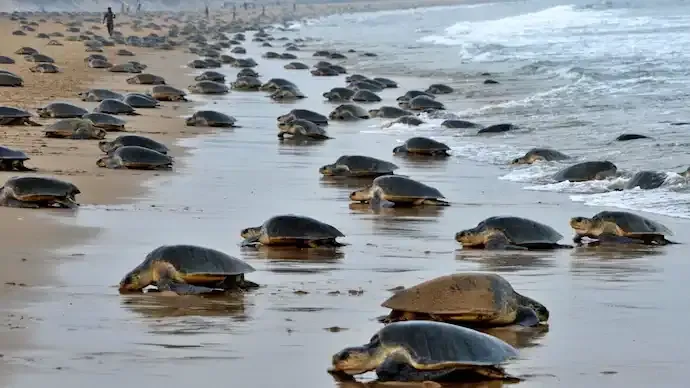

Every year, thousands of Olive Ridley turtles embark on one of nature’s most extraordinary journeys. After spending years roaming vast stretches of the Indian Ocean and the Bay of Bengal, these sea turtles return with astonishing accuracy to the very beaches along India’s coastline where they were born. This remarkable homing ability has long fascinated scientists and conservationists alike.
From the mass nesting beaches of Odisha to quieter shores in Tamil Nadu and Andhra Pradesh, Olive Ridley turtles demonstrate a navigational precision that rivals the most advanced human technology. At the core of this ability lies a biological navigation system often described as a natural GPS.
A Magnetic Map Written Into Biology
Scientific research has revealed that Olive Ridley turtles can sense the Earth’s magnetic field. The planet’s magnetic force varies subtly across different geographic regions, creating unique magnetic “signatures” along coastlines. These signatures act like coordinates on a map.

When hatchlings emerge from their nests and make their first journey to the sea, they imprint the magnetic characteristics of their birthplace. This information is stored in their nervous system and retained for years. As adults, even after migrating thousands of kilometres to distant feeding grounds, turtles use this internal magnetic map to guide themselves back to the same coastal region.
This magnetic sensing is particularly vital in the open ocean, where visual landmarks are absent. By detecting changes in magnetic intensity and inclination, turtles are able to maintain direction and course across vast, featureless waters.
Navigation Beyond Magnetism
While magnetic sensing forms the backbone of long-distance navigation, it is not the only tool Olive Ridley turtles rely on. As they approach India’s coastline, additional environmental cues come into play. Ocean currents help them conserve energy, while wave direction and water temperature assist in fine-tuning their route and timing.
Closer to shore, turtles respond to more local signals such as beach slope, underwater contours, and sand composition. These cues help them select nesting sites that are safer from flooding and erosion, increasing the survival chances of their eggs. This layered navigation system allows Olive Ridleys to remain both precise and adaptable.
Why Odisha Is So Special
India is among the few countries where Olive Ridley turtles display arribada — a phenomenon in which thousands of turtles nest simultaneously. Beaches such as Rushikulya provide the ideal combination of magnetic signatures, coastal geography, and environmental stability that turtles have relied on for generations.
Even turtles that nest individually along other parts of the Indian coastline are guided by the same magnetic memory mechanism, underscoring how deeply ingrained this navigational system is.
Growing Threats to an Ancient Journey
Despite their extraordinary abilities, Olive Ridley turtles face increasing challenges. Artificial lighting along beaches can disorient nesting females and hatchlings. Fishing nets, coastal development, and climate-driven changes to shorelines and ocean currents further threaten their survival.
Scientists warn that altering beaches or disrupting magnetic and environmental cues could interfere with turtles’ ability to navigate. Protecting nesting sites, regulating coastal lighting, and promoting sustainable fishing practices are crucial to preserving this natural phenomenon.
Olive Ridley turtles have followed nature’s invisible map for millions of years. Ensuring their safe return to India’s shores means safeguarding not just a species, but one of the most awe-inspiring navigational systems on Earth.






Conversation
Be kind and stay on topic. Comments are moderated; abuse, spam and personal attacks are removed. Report a problem