

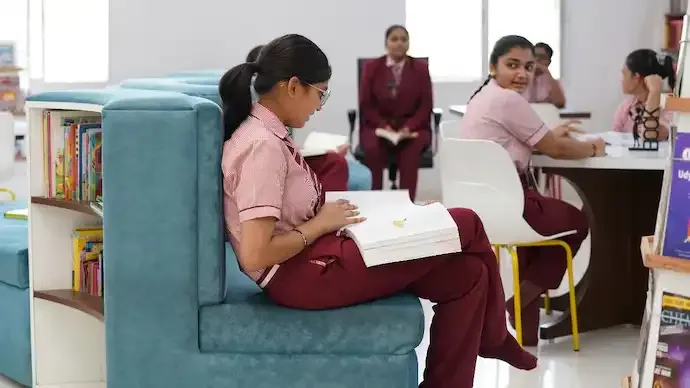

India has over 1.47 million schools, yet fewer than 250 follow the International Baccalaureate (IB) curriculum. This stark contrast highlights how global education remains confined to a small section of society.
While IB programmes are known for their international standards and holistic approach, their reach in India is still extremely limited, especially outside major cities.
High Fees Create a Major Barrier
One of the biggest challenges is affordability. Many schools in India charge as little as ₹1,500–₹2,000 per month, making education accessible to a large population.

In contrast, IB schools—mostly located in metro cities—can charge close to ₹1 lakh per month. This massive gap makes IB education accessible only to affluent families, creating a clear divide between elite and mainstream schooling.
Demand for Specialised Teacher Training
Implementing the International Baccalaureate curriculum requires highly trained educators. Teachers must undergo specialised training to understand inquiry-based learning, global perspectives, and assessment frameworks.
This increases operational costs for schools and makes it difficult for many institutions to adopt the IB system at scale.
Infrastructure and Resource Challenges
IB schools require advanced infrastructure, including:
- Modern classrooms and learning tools
- Access to global resources
- Smaller class sizes for personalised learning
Such requirements are difficult to meet for most schools, especially in rural and semi-urban areas, where basic infrastructure itself remains a challenge.
Limited Presence Beyond Metro Cities
Currently, IB schools are concentrated in metropolitan areas. Smaller cities and towns have very limited access to such institutions, further widening the education gap.
This raises concerns about whether global education models can truly expand across diverse regions in India.
Can IB Education Scale in India?
Experts believe that scaling the International Baccalaureate system nationwide may not be practical in its current form. Instead, there is a growing discussion around adapting its core principles—such as critical thinking, creativity, and global awareness—into India’s existing education framework.
Such an approach could make quality education more inclusive without significantly increasing costs.
The Bigger Question for India’s Education System
The debate is no longer just about introducing global curricula but about making quality education accessible to all. The challenge lies in balancing global standards with local realities.
As India continues to evolve, the focus may shift toward creating a hybrid model that combines the strengths of international systems with the needs of its vast and diverse population.






Conversation
Be kind and stay on topic. Comments are moderated; abuse, spam and personal attacks are removed. Report a problem