



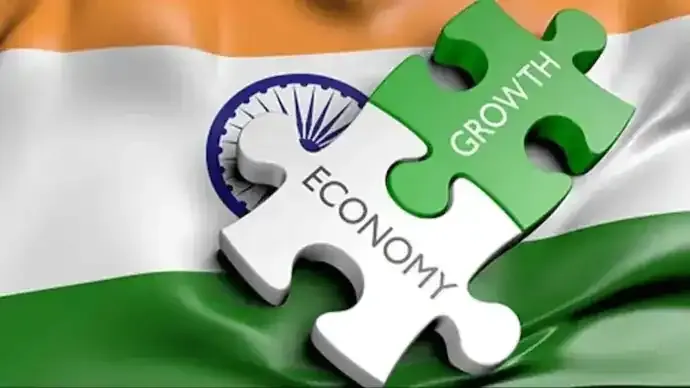
India is on track to achieve a major economic milestone, with projections indicating that the country will transition into the upper-middle income category by 2030 and emerge as the world’s third-largest economy by 2028, according to a recent report by State Bank of India Research.
The assessment highlights how India’s long-term growth trajectory, supported by structural reforms and macroeconomic stability, is accelerating its rise in the global economic hierarchy.
India’s Income Transition: A Long Journey Accelerates
The World Bank classifies economies into four income groups—low income, lower-middle income, upper-middle income and high income—based on per capita Gross National Income (GNI). India moved from the low-income category to lower-middle income status in 2007, a transition that took nearly six decades.

During this period, India’s per capita GNI rose from just $90 in 1962 to $910 in 2007, growing at an annual average rate of around 5.3 percent. Since then, the pace of income growth has quickened significantly.
According to the report, India reached $1,000 per capita income in 2009, doubled it to $2,000 by 2019, and crossed $3,000 by 2026. At the current growth trajectory, India is expected to reach around $4,000 per capita income by 2030, enabling its entry into the upper-middle income bracket alongside countries such as China and Indonesia.
Rapid Expansion of Economic Size
India’s rise in absolute economic size has been even more striking. The country took nearly 60 years after Independence to reach a $1 trillion GDP, but the pace has sharply accelerated since then. India crossed $2 trillion in 2014, $3 trillion in 2021, and $4 trillion by 2025.
The report estimates that India could reach the $5 trillion mark within the next two years, and expand to a $10 trillion economy by 2035–36, assuming current momentum continues.
This expansion is expected to propel India past Germany to become the third-largest economy globally by 2028, behind only the United States and China.
Growth Performance in Global Context
SBI Research notes that India’s relative growth performance has improved steadily over the past decade. The country’s percentile rank in global real GDP growth has moved from the 92nd percentile to the 95th percentile, indicating that India is increasingly positioned among the fastest-growing major economies in the world.
This sustained outperformance reflects a combination of domestic consumption strength, infrastructure investment, manufacturing expansion, and digitalisation.
Path to High-Income Status Remains Challenging
Looking ahead to the government’s long-term vision of achieving high-income status by 2047, the report cautions that growth must remain strong and consistent. At the current World Bank threshold of $13,936 per capita GNI for high-income classification, India would need to maintain annual per capita income growth of around 7.5 percent.
If the threshold rises to $18,000, the required growth rate would increase to nearly 8.9 percent over the next two decades. Factoring in population growth and inflation, this implies sustained nominal GDP growth of around 11.5 percent in dollar terms.
The report stresses that continued reforms, productivity gains, and investment-led expansion will be essential to sustain this trajectory.
India’s projected transition to upper-middle income status and its climb to the world’s top three economies underline the scale of its economic transformation—while also highlighting the challenge of maintaining momentum in an increasingly competitive global environment.






Conversation
Be kind and stay on topic. Comments are moderated; abuse, spam and personal attacks are removed. Report a problem